Shipshewana
Davistown and Summeytown
Published . Last updated .
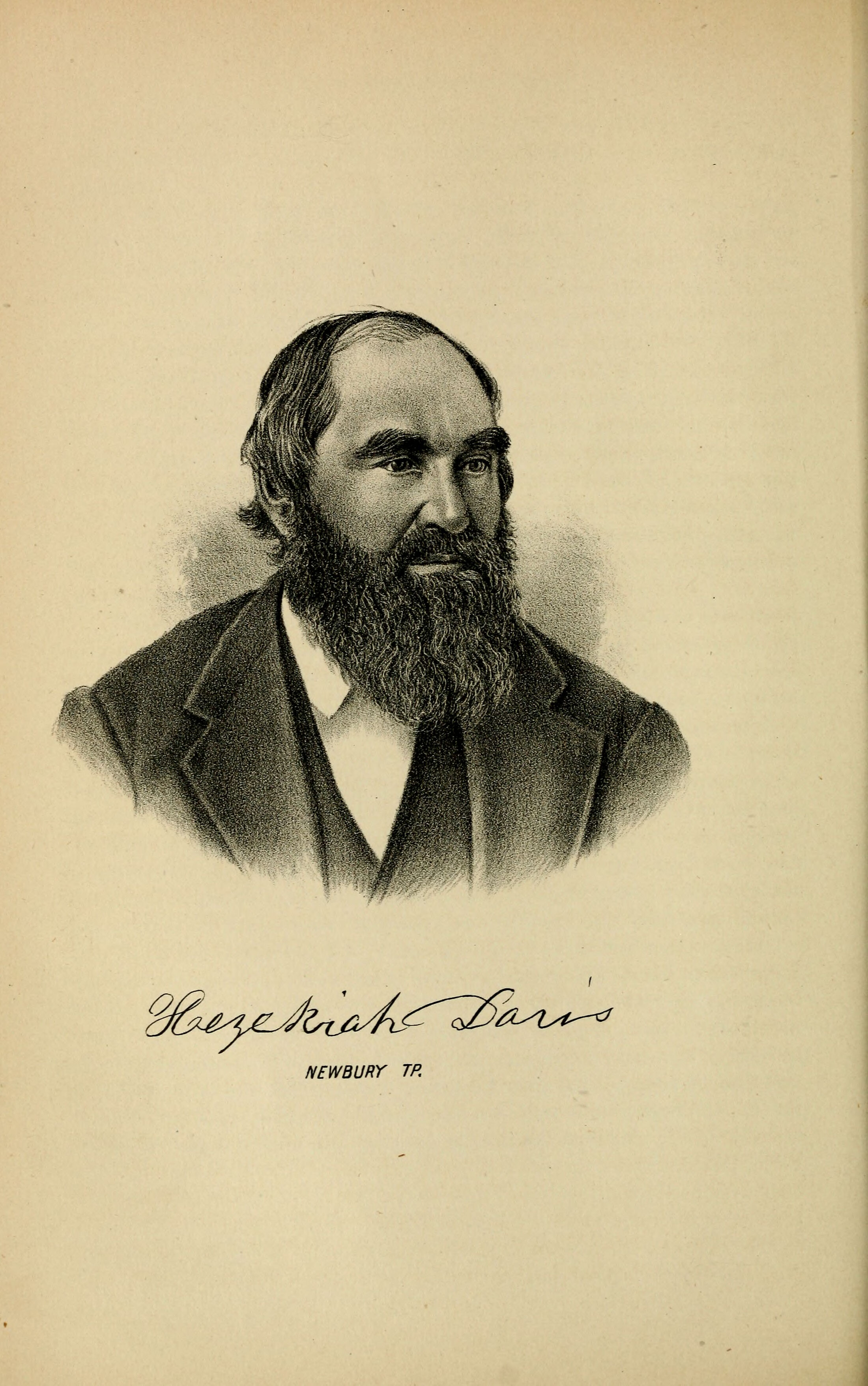
Hezekiah Davis came here in 1836 with his family. He was ten.
By the time he was done he owned more than fourteen hundred acres, and almost all of it lay east of the road that is now State Road 5.
Abraham Summey arrived in 1851 with two hundred eighty dollars. He bought eighty acres, added a hundred more, sold the lot in 1866 for eighty-four hundred dollars, and bought the farm he kept for the rest of his life. Five hundred seventy-two acres, on the west side of the same road.
Two men, two fortunes made out of the same township, on opposite sides of one street.
The 1882 county history has a biography of each of them.
Davis gets the longer one. The bee trees he and his father found, fourteen of them in half a day. The four hundred dollars saved by twenty-three. The first reaper in the township, and the first harvester, and the first binder. Fourteen hundred acres and forty thousand dollars out at interest. Eighteen hour days.
Summey gets a shorter entry in the same section. York County, Pennsylvania, born 1827. Wayne County, Ohio, at ten. Newbury Township at twenty-four with two hundred eighty dollars. German Baptist. Republican. Raised fifteen hundred to two thousand dollars of stock a year. His education, the book says, was principally self-acquired.
In the autumn of 1854 the Dunkards held their first meeting in this township in his house.
The two entries sit a few pages apart in the same volume. Neither one mentions the other man. Neither one mentions a town.
There was no town yet. That is the thing to hold onto.
The 1882 book cannot tell you about Shipshewana because in 1882 there was no Shipshewana. There were two men with two farms and a road between them.
What happened next is not in that book, and it is not in the one that came after it either.
According to the marker, Davis decided a town was needed as the population grew, and he understood that a town needs a railroad.
He paid ten thousand dollars to bring one.
Then he put up two large brick buildings on opposite corners of Main and Morton, both of them facing the depot, and businesses came to them. The place was called Davistown.
Summey, watching that happen on the other side of the road, developed his own land the same way. The marker calls it Summeytown.
Then it says this, in one sentence and without elaboration.
The rival developments generated animosity and suspected vandalism on both sides. This continued for several years.
On the nineteenth of April, 1877, Eugene Davis married Alice Summey.
He was Hezekiah's son. She was Abraham's daughter. The date is in the 1920 county history, in the entry for Eugene, which records the marriage and says nothing whatever about what it meant.
The marker puts it plainly. In spite of the bitter rivalry between these two prominent families, Eugene Davis and Alice Summey fell in love and were married. With time, the tensions between the two factions eased.
They married twelve years before either half of the town was platted.
In January of 1889, Davistown was platted as Shipshewana. The town's own piece tells that year from the county histories, which never mention that there were two towns to join.
The county's record of original village plats gives the date as the eighteenth and puts it in section 12, and names the two people who filed it. Hezekiah Davis and Sarah R. Davis.
The name came from her.
The marker says the town was named by Hezekiah's wife, Sarah Reynolds Davis, honoring a Potawatomi chief who had befriended the early settlers.
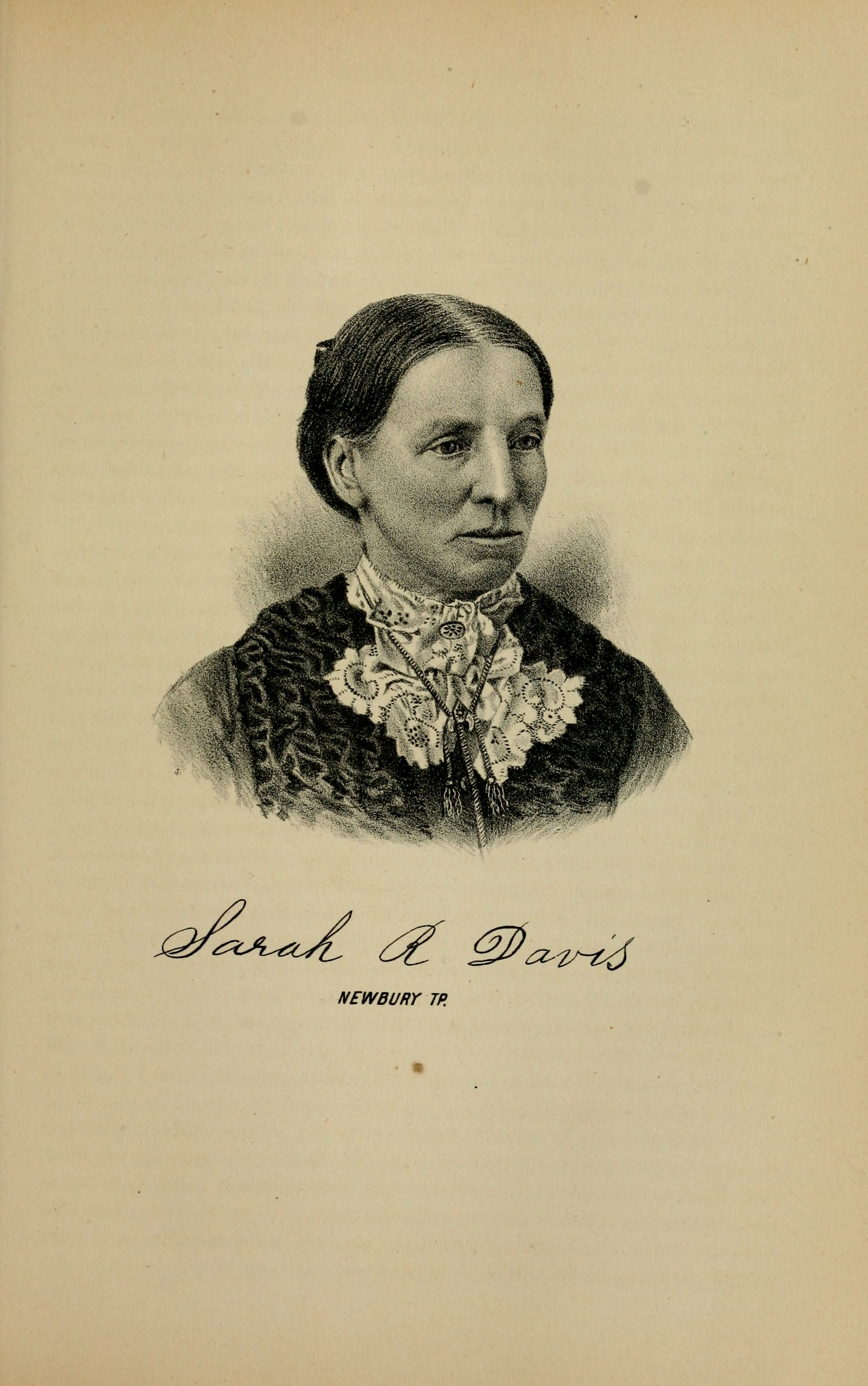
That is not in either county history. Not in Battey, who printed her portrait over her own signature and listed it in his contents as Davis, Mrs. Hezekiah. Not in Ford, whose own chapter on the township says the town was platted by Hezekiah Davis and stops there, while his plat record two hundred pages away carries both names.
The woman the 1882 book's contents could not name without her husband named the town.
On the fourth of April, seventy-six days after the plat, Summeytown became the First Summey Addition to Shipshewana.
Thirty-three years after the plat, the town those two farms became held its first livestock auction, which is what most people outside Indiana know it for now.
That last detail explains something that looked like a hole in the record.
Ford's list is headed original village plats, and it says so. Summeytown is not on it, and for years that would read as the man being left out of his own town's history.
He was not left out. He was in a different part of the record. An addition is not an original plat, and the list never claimed to hold one.
The filings kept alternating, and the 1893 county atlas lists them. Davis's first addition on the fifth of May, 1890. Summey's second on the fifth of January, 1891. Summey's third on the nineteenth of December that year. Davis had filed a second by 1893, and the atlas calls it recent.
Two families filed against each other for three years, and the record kept it.
Hezekiah Davis died in 1891, two years after the plat was filed. Abraham Summey died in June of 1900.
Sarah outlived them both.
Ford's 1920 history says her husband organized a private bank in Shipshewana and was its president until he died, and gives the year as 1889 in one volume and 1890 in the other. Ford describes what the bank became: the old Bank of Shipshewana, a private concern owned by H. Davis and his mother, Sarah R. Davis.
The H. Davis is Hewlitt, the youngest of their seven children, spelled that way in the 1882 history and in his own biography in Ford, and Hewlett in Ford's chapter on the banks. Ford says he joined his mother at the bank in 1893, he as cashier and she as president, and that it stayed that way until he organized the Farmers State Bank in October of 1907. Fourteen years. The 1893 county atlas also names her as president, and names Francis H. Halbert as the cashier.
Ford dates the Farmers State Bank of Shipshewana to 15 October 1907 and calls it the direct successor of the private bank. He gives no date for the private bank's closing.
The same chapter adds, in a separate sentence and without further comment, that it has been robbed four times.
Four volumes of published county history cover this township at length. Between them they carry a biography of Hezekiah Davis, a biography of Abraham Summey, the plat date, the marriage date, the bank, and portraits of Hezekiah and Sarah engraved on their own leaves.
None of them says the town was two towns. None of them says who named it.
That is on a marker at the corner of Main and Morton, on the ground where Hezekiah Davis built his two brick buildings facing the depot.
It was put up in the year 2000, by the Town of Shipshewana and by the Davis and Summey descendants together.
The text is signed Doris Davis.
Sources
- Shipshewana / Chief Shipshewana (Shup-she-wah-no), historical marker at Main and Morton, Shipshewana, Indiana. Text signed Doris Davis, 2000. Erected by the Town of Shipshewana and the Davis and Summey Descendents. Marker text photographed at the Shipshewana Historical Society Museum, 4 August 2026. Historical Marker Database marker 95561
- Counties of LaGrange and Noble, Indiana: Historical and Biographical. Newbury Township biographical sketches and the list of illustrations, F.A. Battey & Co., 1882. Internet Archive. Carries both biographies and both portrait plates
- Illustrated Atlas and Columbian Souvenir of LaGrange County, Indiana. Printed pages 106 and 107, the town of Shipshewana and the Hezekiah Davis sketch, LaGrange Publishing Company, 1893. Internet Archive. Carries the plat and addition dates, Davis Hall and the Shipshewana Bank, the Hotel Davis opposite it, the Summey block on the west side, and Hezekiah Davis's death on 26 September 1891. Read off the page images rather than the OCR
- History of Northeast Indiana: LaGrange, Steuben, Noble and DeKalb Counties. Volume 1, the plat record, the Newbury chapter and the banks chapter; volume 2, the Davis and Summey family entries, Ira Ford, 1920. Internet Archive. Carries the plat date and both Davis names, the marriage, the bank, and both deaths. Volume 1, printed pages 56 and 57, gives the private bank as organized in 1890 and the Farmers State Bank of 15 October 1907 as its direct successor; volume 2, printed pages 401 and 402, the biography of Hewlitt Davis, gives the private bank as organized in 1889 with Hezekiah its president until his death, and Hewlitt as cashier with his mother as president from 1893 until October 1907. All read off the page images
The account of the two towns comes from a single source: the historical marker at Main and Morton, erected in 2000 by the Town of Shipshewana together with the Davis and Summey descendants. The two towns, the ten thousand dollars paid for the railroad, the vandalism, and the naming of the town rest on it and on nothing else, and the piece attributes each of them to it rather than stating them flat. Where the marker can be checked against the 1882 county history it holds: it puts Abraham Summey's arrival in 1851 and his larger farm in 1866, and the 1882 biography independently gives both, including the sale that year. The marker text is signed by a Davis, which is one of the two families whose rivalry it describes. The 1893 county atlas was added to this piece on 2 September 2026 and it changes that split. It dates the first Summey addition to 4 April 1889 and lists the three that followed, where the marker gives them undated, and it carries the two brick buildings independently: a three-story brick Davis Hall holding the Shipshewana Bank, with Sarah R. Davis as president, and the Hotel Davis opposite, both of which it says Hezekiah Davis built. The two buildings are therefore no longer marker-only. The two towns by name, the ten thousand dollars for the railroad, the vandalism and the naming of the town still are.
Since publication
Correction ·
This piece said the First Summey Addition was recorded in the fall of 1889. It was recorded on the fourth of April, seventy-six days after the original plat, according to the 1893 county atlas, which is the only source in this archive that dates it. Nothing supported the fall.
Correction ·
This piece said the 1882 book could not name Sarah R. Davis without her husband. That is true of its contents, which list her portrait as Davis, Mrs. Hezekiah. It is false of the book. The plate is signed Sarah R Davis, Newbury Tp., in script under the portrait, and this piece has been publishing that plate at the head of the page since it went up. The sentence now says contents, and the Battey sentence now says the portrait carries her own signature. Nothing new was needed to catch this and nothing new was used to fix it: the disproof was two screens above the claim.
Correction ·
This piece said the private bank closed in October 1907, when Hewlitt Davis organized the Farmers State Bank. The 1920 county history calls the new bank the direct successor of the private one and gives no date for the private bank's closing. The closing date was our inference, published as a fact.
More from Shipshewana
Shipshewana
Now president
Sarah Reynolds Davis was president of a Shipshewana bank for fourteen years. The 1893 atlas photographed her beside it, gave the building to her dead husband in the caption, and named her president in the text. No county history records when she died.