LaGrange
No more reliable account
Published . Last updated .
Dr. John H. Rerick signed four chapters of the county history published in 1882: the county's physical features, its organisation, its roads and churches and schools, and its part in the war. No other man in the volume signed more.
He also owned the LaGrange Standard, and had owned it, with one interruption, since 1867.
Two years before the county history came out he had written another book.
The regiment
The Forty-fourth Indiana held a reunion in 1879 and asked him to write its history. He printed it in LaGrange the following year, three hundred pages of roster, marches and losses by company, and he opened it by saying what he had to work with.
Although the writer was with the Regiment during every day of its service except when absent a few weeks on sick furlough, he finds that time has dimmed in his memory many incidents of a personal character, that might be of interest.So he used his own wartime letters, the official records, and soldiers' letters that had been published at the time.
He had been there. He was commissioned assistant surgeon on the twelfth of September, 1861, promoted surgeon, and mustered out a major. At Shiloh the regiment's casualty return lists him among the wounded, hit in the chest.
What he does at the battles
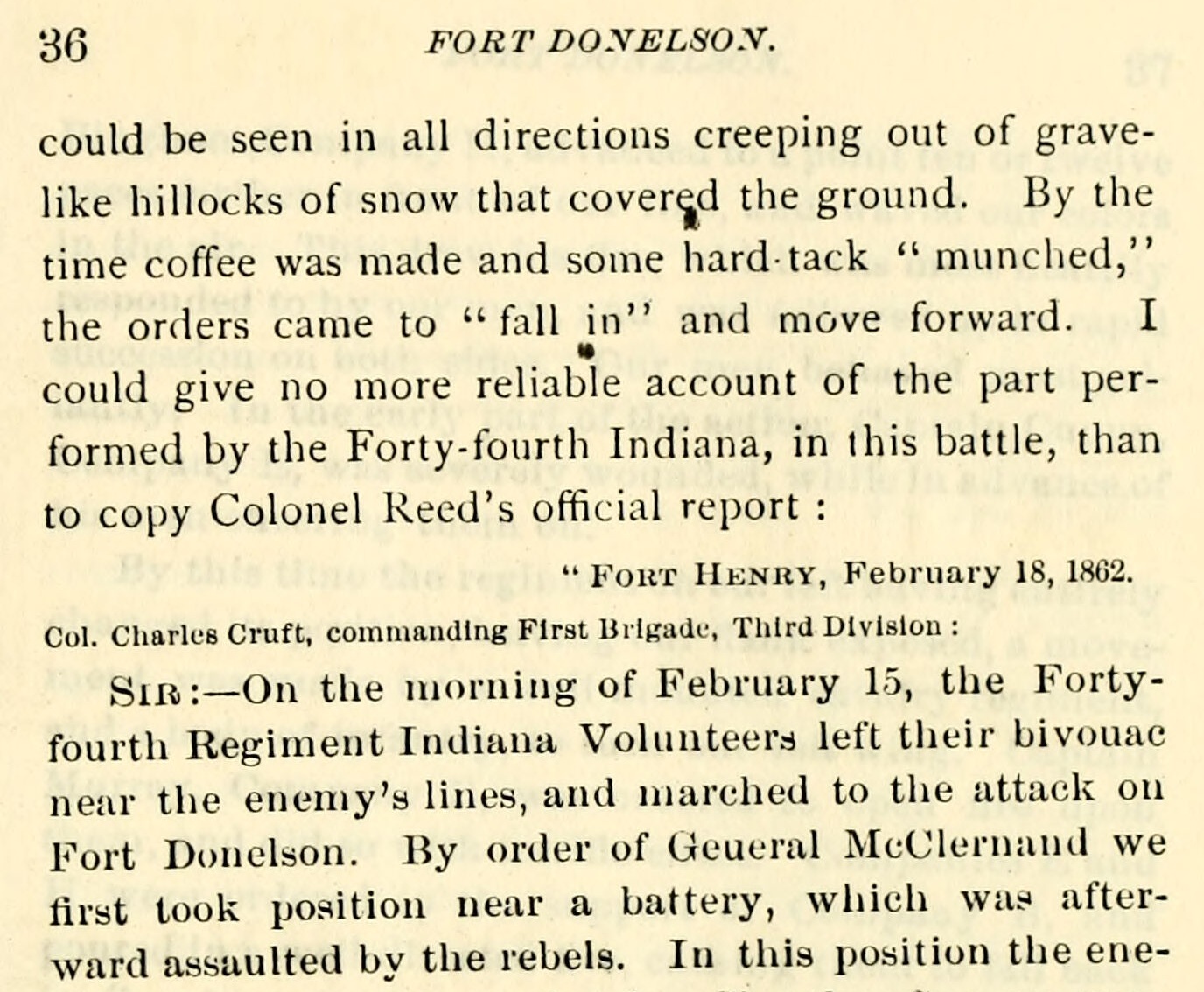
The book reaches Fort Donelson in February 1862. He describes the snow, the coffee, the hard-tack, the order to fall in. Then he stops.
I could give no more reliable account of the part performed by the Forty-fourth Indiana, in this battle, than to copy Colonel Reed's official report.
Four pages of Colonel Reed follow.
At Chickamauga he does it again, and the seam is easier to see because the march is his and the battle is not. He gives the division breaking camp on the third of September, the crossing of the Cumberlands, Rossville, Ringgold, the skirmish at John Henderson's plantation on the thirteenth, the clouds of dust to the east on the sixteenth and seventeenth, and two regiments ordered out late on the afternoon of the eighteenth. The next paragraph is this one.
For the part performed by the Forty-fourth on the bloody field of Chickamauga, we subjoin the official report of Lieutenant-Colonel Aldrich, the brave and intrepid officer in command.
Aldrich covers both days of the battle, Saturday the nineteenth and Sunday the twentieth, and reports three killed, fifty-one wounded and ten missing. He also reports this.
The ever faithful Surgeon Rerick followed us from point to point, assisted by Dr. Carr; and I am pleased to say that no regiment has had better care for their wounded than the 44th Indiana, in this army. He succeeded also in getting all of our wounded from the hospital which was captured on Sunday evening by the enemy.
Then Rerick's own voice returns, and the first thing it does is defend the document.
The report of Lieutenant-Colonel Aldrich might seem somewhat colored to some, but the above facts obtained by Chaplain Van Horne from official reports of his superior officers, fully vindicate the Colonel's plain statement of the part performed by the Forty-fourth Indiana.
He does not mention that the report he is vindicating names him.
At Stone River he writes the fighting himself, seven months earlier and two battles back. That account ends: Having been an eye-witness of nearly all its movements, I can testify as to its honorable conduct.
The paper
John K. Morrow came in from Bryan, Ohio, in December 1856, with a Washington hand press and printing material covered with a chattel mortgage. The Standard began printing early the following year. It was the first Republican paper established in the county.
Rerick bought the office on the twenty-second of November, 1867. He sold it to John D. Devor in May 1869, on his election as clerk of the circuit court, and bought it back on the eighteenth of July, 1872.
In between, Devor put twenty-five hundred dollars into it: a new Washington hand press, two job presses, a large quantity of type. So the office Rerick returned to was not the office he had left. In October 1874 he added the first power press ever brought into the county, and steam to turn it.
The book about the county
F. A. Battey and Company of Chicago worked the two counties through 1881, calling on upward of three thousand people, and published the volume the next year. Different men wrote different chapters. Weston A. Goodspeed signed five of the township chapters. John Paul Jones signed two. Five more are signed R. H. Rerick. Ford's history gives R. H. Rerick an entry of his own in 1920, naming him the author of the Eden Township chapter, and he took the Standard in 1914. Nothing in either volume establishes how the two were related, or whether they were.
The four that carry Dr. J. H. Rerick, M. D. are the county-wide ones, and three of them have him in them.
He wrote the chapter that lists the county's physicians, and his own entry is in the third person: came to the place in 1859, entered the service in 1861, promoted surgeon, still proprietor of the Standard, and devoting his attention exclusively to the printing business.
That entry says he was elected clerk of the circuit court in 1860 and in 1864, serving eight years.
The table of county officers, a hundred lines further into the same chapter, reads: John H. Rerick, 1869-77.
Both are his. The volume does not reconcile them and neither does this.
He wrote the chapter recording that on the ninth of January, 1858, a meeting at Wright's Corners passed resolutions signed by a hundred and thirty citizens and ordered them published in the Standard, accusing a tavern keeper of harbouring what the resolutions called these infernal banditti. That was nine years before he bought the paper. The same chapter, two hundred lines later, records that he owns it. It does not put the two together.
And he wrote the chapter listing what went into the courthouse cornerstone in 1878, read out by Samuel P. Bradford as the box was closed. The 1832 act organising the county. The April bar docket. Six Confederate postage stamps found in a rebel camp in Virginia. The names of the Lima Silver Band. A coin dated 1771 and a silver coin dated 1774. A Swiss medal. And, third on the list, a copy of the La Grange Standard, Centennial issue, and issue of the day.
He was still the proprietor when the book went to press.
He died on the twenty-first of January, 1911, still holding the paper. It was leased to Carl H. Rerick, and from 1914 it belonged to Rowland H. Rerick.
Sources
- Counties of LaGrange and Noble, Indiana: Historical and Biographical. Chapters I, II and III, the county organization chapter, and the Town of LaGrange biographical sketches, F.A. Battey & Co., 1882. Internet Archive. Carries the four chapter bylines, the physicians sketch, the clerks table, the newspaper history and the cornerstone box
- The Forty-Fourth Indiana Volunteer Infantry: History of its services in the war of the rebellion, and a personal record of its members, John H. Rerick, 1880. Internet Archive. Printed at LaGrange. Carries the preface, the Fort Donelson and Chickamauga handoffs, the Stone River narrative and Aldrich's report
- History of Northeast Indiana: LaGrange, Steuben, Noble and DeKalb Counties. Volume 1, the newspaper chapter; volume 2, the biographical sketch, Ira Ford, 1920. Internet Archive. Gives the death date, the Kendallville partnership, and the paper's descent to his sons
Both county histories are scanned text. Obvious scanning errors are corrected and no wording is altered. The death date rests on Ford alone, published nine years after it; no obituary is held and the Standard's own files are not in this archive. The clerk of court dates contradict each other inside the chapter Rerick signed, and this piece states both and resolves neither. THE FOUNDING DATE IS TWO DATES AND THE SOURCES SPLIT ON WHICH ONE THE PAPER GETS. Battey dates December 1856 to Morrow's arrival, writing that he moved in and at once commenced the issue. Ford separates the two events, putting the press on the road from Bryan in December 1856 and publication beginning early in 1857, and he notes the Republican party was itself started in that year. The 1893 atlas dates the paper to 1857 twice, in its chronology and in its account of the town. THIS PIECE FOLLOWS THE ISSUE NUMBERING. The Library of Congress newspaper directory describes the Standard from Volume 1, number 41, dated 16 December 1857, and records the paper as a weekly. Counting back forty issues at that frequency puts the first issue in March 1857, and a paper founded in December 1856 would be near number 54 and into volume 2 by that date. THAT ARITHMETIC IS OURS AND NOT THE DIRECTORY'S, which states the volume and number and nothing further. What the directory supplies is the paper's own masthead, and it is the only evidence here from outside the county histories. Ford agrees with it. Battey is Rerick's account and the atlas is a volume he appears in. WADDELL 1936 IS NOT A FOURTH WITNESS. Rose Marjorie Waddell's History of LaGrange County, compiled from Standard and News centennial matter and on the Internet Archive since August 2025, says Morrow came from Bryan in 1856 and printed the first Standard that year. It reads as independent corroboration of Battey and it is not: its early-history chapter opens by stating that the material was written by Dr. John H. Rerick, editor of the Standard for many years. It is Rerick's account a fourth time. Do not count it against the numbering.
Since publication
Correction ·
This piece said the Standard began in December 1856, when John K. Morrow arrived from Bryan with his press. December 1856 is the date the county history gives for Morrow's arrival. Ford's 1920 history is the only source that separates the two events, and it puts the press coming overland in December 1856 and publication beginning early in 1857. The 1893 county atlas dates the paper to 1857 in both its chronology and its account of the town. This piece now gives the arrival and the founding as two things.
More from LaGrange
LaGrange
What the county seat gained and lost
Between 1901 and 1910 LaGrange got a telephone exchange, a fire station, a post office, a pickle factory and an ice cream factory. In the same nine years it lost two churches, a hotel and every printing office in town.