Stroh
Four hundred and eighty barrels
Published .
In 1982 the county remembered a fishing trip, marl on a man's shoes and a thousand barrels of cement a day. The state geologist had recorded four kilns able to make four hundred and eighty. The records go on to say how the works ended.
The story the county told about itself in 1982 begins on a lake.
A sesquicentennial section dated the sixth of October that year, later bound into the booklet 7 Score and 10, says the development of Stroh and Elmira, one could say, began with a fishing trip in the late 1800s.
Emil Stroh of Detroit, it says, was in the county visiting his wife's family and went out fishing on Big Turkey Lake. Walking up from the boat he found marl on his shoes, and had a sample tested in Detroit.
No record reached for this piece mentions the trip.
The county history of 1920 tells the same beginning without a lake in it. The industry, it says, began in 1899 because a good clay and a stone fit for cement were found there.
Two accounts of the same beginning. One of them is a story, and says so in its first line.
How the town was platted and named, how the kilns were added, who controlled the company and who ran its laboratory, and how many men worked there are all in Exclusively in the rich soil, along with the county historian's verdict of 1882 on what this ground was worth. The bank is in Thirty-five names.
The 1982 section goes on to quote an account written in 1969 by Marguerite Forst, and that is where the numbers are.
At the start, she wrote, a thousand barrels a day were produced. The factory was remodelled in 1918, and after that, twenty-eight hundred barrels a day could be produced.
The state geologist, W. S. Blatchley, describes the plant in its first months in the Twenty-Fifth Annual Report of Indiana's Department of Geology and Natural Resources, the report for 1900, printed at Indianapolis in 1901. It began making cement in August of 1900, with four rotary continuous kilns, 60x5 feet in size, with a total daily capacity of 480 barrels.
The county history gives the same first kilns a daily capacity of six hundred barrels. It puts the rebuild in 1915, not 1918, and gives the three large kilns that came out of it a daily output of two thousand.
The numbers do not all measure the same thing. The state geologist and the county history give what the first kilns could make, and Forst's thousand is what she says they did make, more than twice the state's figure. Her twenty-eight hundred is what the new kilns could make, and the county history's two thousand is what they did. Read either way, every figure she remembers is higher than the one in print.
Of the figures here, only the state geologist's stand apart from the county history. The 1920 book is one compiler's work, and for the rebuilt kilns his are the only figures this archive holds.
There is one more difficulty with Forst's figures, and it is on the page. The section introduces her account with a colon and an opening quotation mark, and never closes it. The article runs to its last line without one. Everything after that mark reads as hers, and the page never says where she stops, so the thousand barrels and the twenty-eight hundred are hers only as far as that one mark can carry them.
The county history stops in 1920. The works did not.
In December of 1932 the trade monthly Concrete reported that the Wabash Portland Cement Company, then running plants at Stroh and at Osborn in Ohio, was taking up a new product.
Forst remembered the end. The plant whistle, she wrote, went quiet in the autumn of 1941, when the plant closed. That is a memory, and no record reached for this piece gives the month the kilns went cold.
The record picks up the next summer. In July of 1942 Pit and Quarry carried an item, hedged in its own words as something reported, that the Stroh plant is being dismantled, its usable equipment bound for the company's plant at Osborn and the rest for scrap. It added that the plant was among the last still making cement from marl.
By late August the Wabash had asked the Interstate Commerce Commission, in Finance Docket No. 13888, for leave to abandon the branch, 4.83 miles from Helmer to Stroh. Traffic World gave the railroad's reason: Available traffic was insufficient to justify continued operation of the Stroh branch. The carrier added that its abandonments would free rails and fastenings wanted elsewhere for the war.
The Commission granted it in a supplemental decision, which Traffic World reported in February of 1945. The Commission's own decision has not been read for this piece, and the grant is known here from the paper's report of it. The trade papers that carry the end are still in copyright, so they are quoted here in phrases and cited.
The spur that the first piece describes, running out of Helmer to what the 1920 history called the famous cement works, is the branch the Commission let go.
Brittney Messer brought the 1982 article to the Gazette.
Sources
- Elmira, Stroh products of cement factory, page 22 of a sesquicentennial section dated 10-6-82, in 7 Score and 10: LaGrange County's 150th Year, LaGrange Publishing Co., 1982. Internet Archive, leaf 85. In copyright, quoted in phrases only. The fishing story is the section writer's; the figures, the 1918 rebuild and the whistle are inside an excerpt from an account by Marguerite Forst, 1969, which opens with a quotation mark and is never closed on the page.
- Portland Cement, in the Twenty-Fifth Annual Report of the Department of Geology and Natural Resources of Indiana, W. S. Blatchley, 1900. Internet Archive. Printed pages 27 and 28, scan leaves 59 and 60, The Wabash Portland Cement Company: manufacture begun at Stroh in August 1900, the plant between Big and Little Turkey lakes, and four rotary kilns with a total daily capacity of 480 barrels. Title page, scan leaf 13, read off the image on 26 September 2026: Twenty-Fifth Annual Report, W. S. Blatchley, State Geologist, 1900, printed at Indianapolis by Wm. B. Burford, 1901. The table of contents, scan leaf 17, gives Portland Cement, from printed page 1, to Blatchley alone; pages 27 and 28 fall inside it.
- History of Northeast Indiana: LaGrange, Steuben, Noble and DeKalb Counties. Volumes 1 and 2, Ira Ford, 1920. Internet Archive. Volume 1, printed pages 165 and 166, the Village of Stroh: the discovery of a valuable clay and a cement stone, the capacity of 600 barrels, and the daily output of 2,000 barrels after 1915; printed page 273, the spur from Helmer to the famous cement works.
- Concrete, December 1932, 1932. Internet Archive, printed page 12, "Wabash Portland Cement Company to Make Super Cement". In copyright, and paraphrased here.
- Pit and Quarry, July 1942, 1942. Internet Archive, printed page 33, "Report Dismantling of Stroh Cement Plant". In copyright, quoted in one phrase.
- Traffic World, 22 August 1942, 1942. Internet Archive, printed page 426, Wabash Abandonments: the application in Finance No. 13888 and the railroad's reason. In copyright, quoted in one phrase.
- Traffic World, 3 February 1945, 1945. Internet Archive, printed page 254, Wabash: the grant by the Commission's division 4 in Finance No. 13888. In copyright, and paraphrased here. The Commission's own decision has not been read.
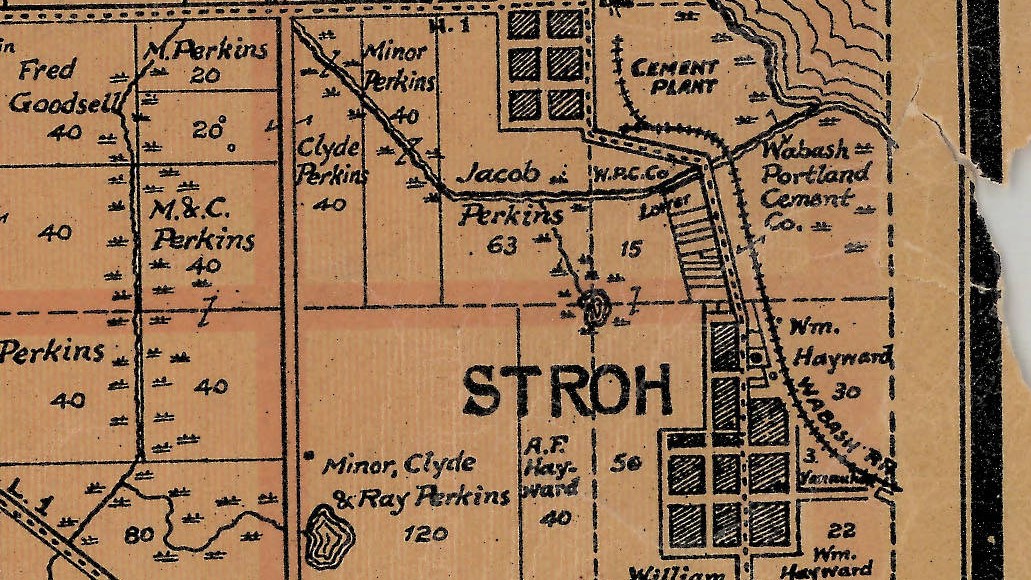
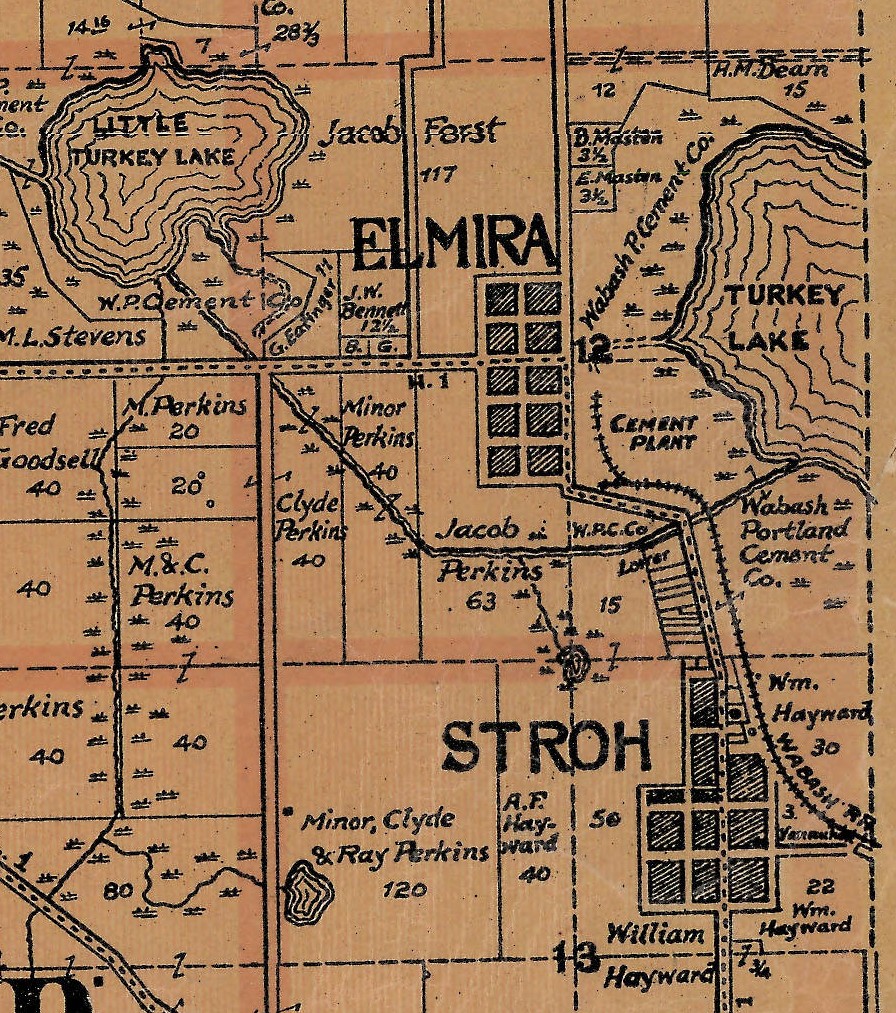
- The 1904 Map of La Grange County, Shepardson and Rerick, 1904. Indiana State Library, Map Collection, Indiana Division. No Copyright, United States. The whole sheet is in this site's Maps section, under 1904.
The 1920 history and the state geologist's report are scanned text. Obvious scanning errors are corrected and no wording is altered. The 1982 section and the trade papers are still in copyright, so they are quoted here in short phrases with their source named, never at length.