LaGrange County
No records could be found
Published .
In November 1937 the federal government sent people to count what this county had kept.
They were the Historical Records Survey, a relief programme that put unemployed clerks and writers to work inventorying county archives, state by state, office by office. Indiana's volume forty-four is this county. It runs to several hundred numbered entries, typed on a mimeograph, and it describes every series of records the courthouse then held: what each one was, what it recorded, how it was arranged, whether it was written by hand or typed, how many pages, how large the book was in inches, and which room it sat in.
The first entry is the one that matters most.
Entry 1 is the commissioners' record. The survey gives it as beginning in 1832, with a dash after the year where a closing date would go, which is how the volume says a series was still being kept in 1937. Twenty volumes, lettered A to I, three hundred and fifty pages each, eighteen inches by twelve by three, kept in the auditor's office. Beneath it, the commissioners' docket, 1866 to 1911, in three volumes.
A hundred and five years of a county's decisions, and the survey found them all.
Most of the volume reads like that.
The clerk's vault held six hundred feet of bound volumes and two hundred feet of unbound records in file boxes, which the survey worked out to be sixty-seven per cent of the clerk's own records, eighty-three per cent of the circuit court's, forty per cent of the coroner's, ninety-one per cent of the primary election commissioners', ninety-three per cent of the board of election commissioners', and all of the board of canvassers'. The other seventeen per cent of the clerk's records were in the basement vault.
The superintendent of schools had a room twenty-four feet by twenty by sixteen on the northwest corner of the first floor, with sixteen feet of shelving, carrying six feet of bound volumes and ten feet of file boxes two feet deep. It held all his records and two thirds of the board of education's. The survey noted that there was space for more shelving, and that people who came to consult the records could be properly accommodated.
That is the tone throughout. Somebody measured the rooms.
Three things were not there.
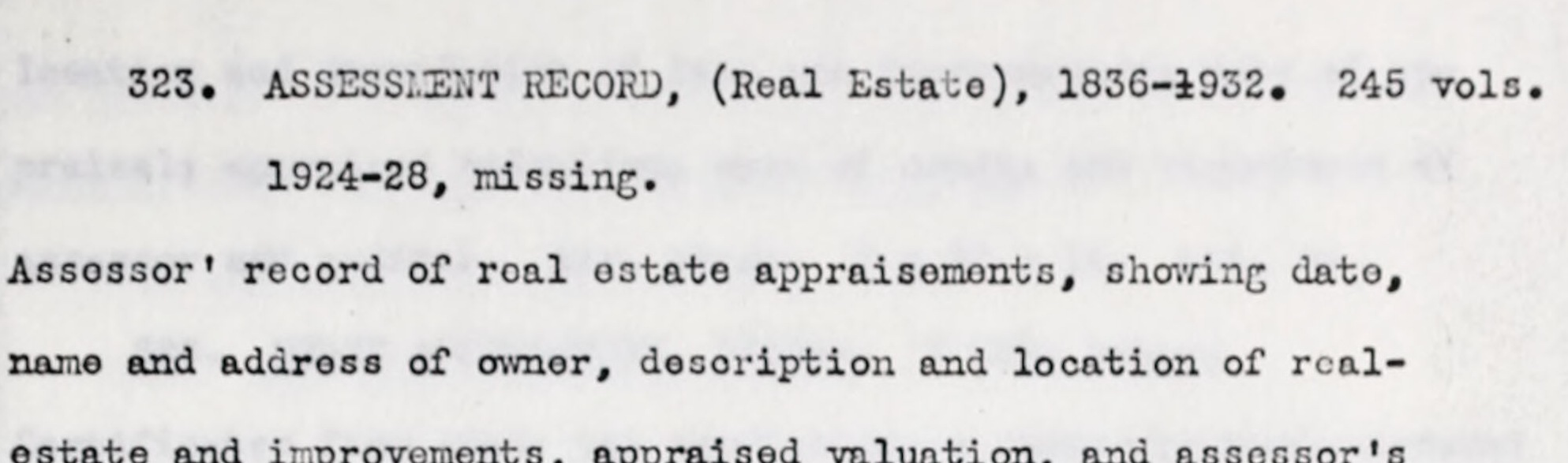
The first is the assessment record for real estate, two hundred and forty-five volumes running from 1836 to 1932, the book in which every parcel in the county was appraised and signed for by the assessor. Five years of it were gone by 1937, and the survey says so in two words under the heading. What survived was split: two hundred and twenty-three volumes, 1836 to 1924, in the auditor's basement vault, and twenty-two volumes, 1928 to 1932, in the commissioners' room.
The second is the assessor's plat book, seventy-seven volumes from 1886, the township plats used to make the assessments. 1925-31, missing. Seven years.
The third is an office rather than a book. The county agricultural agent had existed in law since 1913, to advise farmers and to help the schools teach agriculture. The survey set out his duties, cited the statutes, ruled a line under them, and then typed one sentence where the list of records should have been.
No records could be found.
The volume records no fire and no flood. Nothing in it says a book was destroyed, and the county's own histories carry no such story either. What it records instead is ordinary attrition: two runs of tax books with holes in them, and a young office that had never kept anything, or had kept it somewhere nobody could find in 1937.
One entry in it bears directly on work this archive has been unable to do.
- TRACT BOOK, 1841-46. 1 vol.
A record of lands bought from the federal government, giving the description, the acreage and the location of each tract, the price per acre, the total paid, and the name and address of the purchaser. One volume, a hundred and seventy-five pages, in the auditor's vault.
That is a county copy of the thing the federal land office holds, for the years when this county's land was first being entered. The federal database that would answer the same questions cannot presently be reached by anything but a person with a browser, and the tract book sits in the courthouse. Whether it is still there is exactly the question this inventory was made to let somebody ask.
The survey finished its work and the county went on keeping records. What the volume is now is a baseline: a list, made by people who counted, of what existed on one day in November 1937.
Every question this archive has that ends at the courthouse ends in that list. Whether Milford Township's voters carried an aid subscription in July 1890 is a question for the commissioners' minutes, catalogued here as twenty volumes in the auditor's office. Whether the building at 163 Detroit Street is the one the Olivers put up is a question for the recorder's deeds, catalogued here by the room they sat in.
In 1937 somebody counted them and wrote down where they were.
Sources
- Inventory of the County Archives of Indiana, No. 44, LaGrange County, The Historical Records Survey, Division of Women's and Professional Projects, Works Progress Administration, 1937. Internet Archive, inventoryofcount4419hist, a typed mimeograph of November 1937. Every figure in this piece was read off the page images: entries 1 and 2 on scan leaf 119, entry 323 on leaf 329, printed page 154, entries 337 and 338 on leaf 335, the Agricultural Agent on leaf 421, the clerk's vault on leaf 77 and the superintendent's room on leaf 91. The item record carries no rights statement and no copyright status, so the public domain here rests on what the volume is, a work of a federal programme printed in 1937.
The scanned text of this volume is unusable and it is worth saying how unusable, because it changed two of the three findings. The survey typed its inventory on a mimeograph, and the scan of that page renders dates as 1S64 for 1864 and 1805 for 1865, and titles as CARRIAGE RECORD for MARRIAGE RECORD. On the two losses it is worse than wrong in detail: it makes the plat book gap read as one stray volume when the page says seven years are missing, and it garbles the assessment record's volume count and loses the fact that the surviving books sat in two different rooms. Every number and every quoted line in this piece was read off the page image instead.
More from LaGrange County
LaGrange County
Still lives with Mrs. J. B. Nichols
The 1893 county atlas photographed five of one family and printed them on a single leaf. One caption reads Miss Ann M. Bartlett. It is the only caption in the volume naming a woman who is not somebody's wife, and nothing in four volumes gives her a birth, a marriage or a death.