Howe
The town that has had three names
Published .
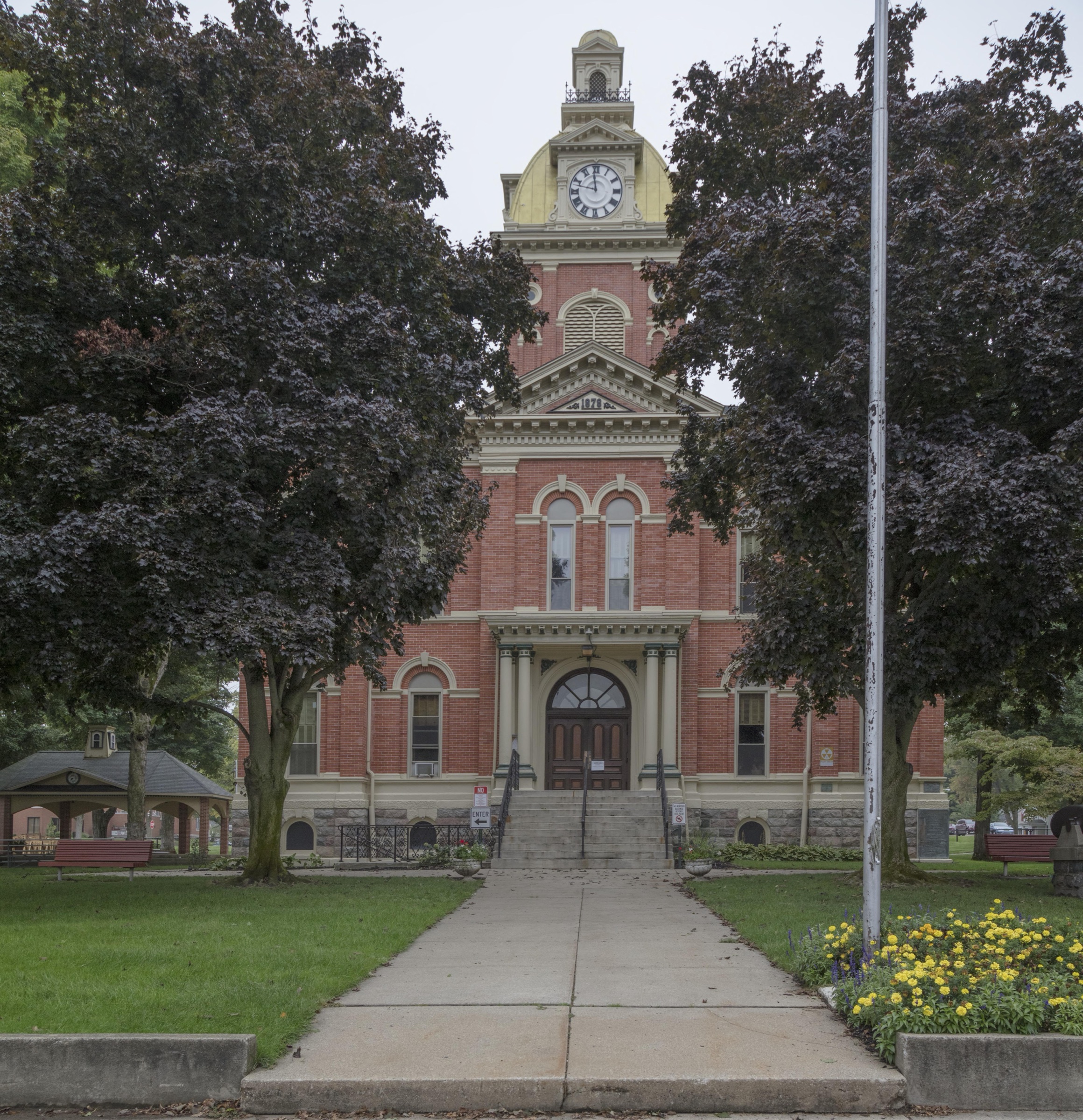
There was a Potawatomi village here first, on the Mongoquinong Prairie, which ran from the far side of Cedar Lake out to where Lima would be. It was called Mongoquinong. Trails ran from it south to Fort Wayne, north into Michigan, west to the St. Joseph mission, and out to the Haw Patch. The 1882 county history gives the English rendering as Big Squaw and notes, a little wistfully, that the name untranslated is the better of the two.
The first white settlers arrived in 1828. Nathan Fowler, said to have been a soldier of the Revolution, put up a log cabin on the north side of Crooked Creek, almost directly north of the village. Late that same year Benjamin Blair built one about half a mile west of it, which is counted as the first permanent white settlement in what became LaGrange County.
Moses and Ica Rice came the next year. One of them opened a trading post to barter with the Potawatomi. The other built the first cabin in what is now the southern part of town.
By 1828 there were perhaps thirty wigwams left at Mongoquinong, scattered along the Pigeon. The government removed the Potawatomi about 1839.
The county was organized on paper in 1832. The first court convened on October 22 of that year at Moses Rice's house. It was called to order outdoors, between two haystacks, and then everyone went inside.
The seat of justice landed here, and the Rice brothers paid for it. When the village was surveyed in 1834, eighty-four of its two hundred eighty-six lots were handed to the county, along with the public square and two acres for a cemetery, which is Riverside now. A frame courthouse went up on the square. A frame jail went up on the southwest corner of it.
Somewhere in 1833 or 1834, by a special act of the state legislature, Mongoquinong became Lima.
Lima grew fast. Lawyers, constables, and judges turned up the way they do wherever the county business is.
One of them was twenty years old.
John B. Howe was born in Boston in 1813, the son of an Episcopal preacher who had gone to Harvard. He finished Trinity College in Hartford at nineteen, went to Detroit in the autumn of 1832, spent a year reading law in Michigan offices, and then picked this place on purpose. He picked it because it sat between two rivers, and in 1833 everything had to be on water.
He taught the first school in LaGrange County that year, in a log building a quarter mile southeast of the village. Eighteen or twenty students. Ten or twelve dollars a month.
In 1834, at twenty-one, he became the first lawyer admitted to the LaGrange County bar.
The county seat did not stay.
As the middle and southern townships filled in, the argument started, and it was not really an argument about Lima. Nobody disputed that Lima was a fine town on good ground. The problem was arithmetic. The county is sixteen and a half miles deep by its own organizing act, which is two full six-mile tiers and a short one, so the top tier where Lima sits is four and a half miles deep because the Michigan line cuts it short. Lima was excellent and it was not in the middle.
The fight went to the legislature and by the 1882 account Lima was winning it. Then Lima stopped.
The county history puts it plainly. Lima saw that the contention would produce a great deal of ill feeling, and that the question would never really be settled even if she won it. So she gave it up, and the geographic center was agreed on instead.
The geographic center was a hilly swampy spot on Fly Creek under heavy forest and, in the words of the county history, a luxurious growth of blackberry brambles that took years to exterminate. They platted the town of LaGrange there in 1836, settled it in 1842, built a courthouse in 1843, and moved the seat in 1844.
Lima's courthouse became a school, then a hotel, then a doctor's office. It burned down eventually.
Then the ordinary thing happened, slowly.
The county fair was held at Lima in 1855 and moved permanently to LaGrange the next year.
By 1880, when the census takers came through, every township in LaGrange County had gained people over the previous decade. Bloomfield, which holds the county seat, was up more than three hundred. Newbury was up two hundred and thirty.
Every township except one. Lima had 1,371 people in 1870 and 1,336 in 1880.
Thirty-five people is not a catastrophe. It is not a story anybody told at the time. It is just the arithmetic of a place that was the center of something and then was not, and the census is the only record that bothered to notice.
John B. Howe stayed.
He represented four counties in the state legislature in 1840 and sat in the Indiana Constitutional Convention in 1850. He founded a bank in Lima in 1854 with Samuel P. Williams, and it did well enough to become a branch of the State Bank of Indiana and then a national bank. In his later years he wrote four books on financial questions and gave speeches around the state.
In August of 1878, two thousand people gathered in LaGrange to watch the cornerstone laid for the courthouse that stands there now. Howe spoke. He said he thought he was probably the only person present who had settled in the county as early as 1833, and then asked whether anyone else had, and nearly a dozen hands went up.
He said the changes had been remarkable and the progress almost too rapid. He said the new building would cost as much as the whole county had been worth when he arrived. He said he did not believe in expensive and ornamental courthouses, that they should be like justice itself, simple and unostentatious, but that it was the fashion now and people could not bear to be behind their neighbors. He said he was willing to pay his part and only mentioned the cost as a matter of contrast.
Then he sat down and they laid the stone.
In the winter of 1850, LaGrange County sent him to Indianapolis to help write a new state constitution.
The convention took up a section barring Black people from entering or settling in Indiana. A delegate from Monroe proposed that any who came anyway be sold to the highest bidder. A delegate from Jefferson moved that members of the convention be required, whenever they saw a Black person in the state, to catch him and take him out. Fifteen men voted for that one.
Howe spoke against the section, and he began by making clear what he was not. He told the convention that whether the abolitionists were acting from good motives or bad had very little weight with him. He called himself a conservative. His argument was narrow and legal: a free Black citizen of New York or Massachusetts could cross into Indiana and buy and hold property here, and the state had no power to stop him. Pressed by another delegate, he agreed that such a man would not be entitled to vote in Indiana.
Then he stopped arguing law.
He said a constitution is made for the benefit of the minority, to protect its rights against the aggressions and the power of a triumphant majority, and asked what use a constitution is unless the object is to protect the weak. He said the proposal to sell Black immigrants at auction was the very next thing to the adoption of slavery itself. He said that if the section went into the constitution it would remain there long after the supposed exigency that called it forth had passed away, a monument of infamy more durable than brass to the character of the state. He said the measure was certainly tyrannical and probably impracticable, and that if it was impracticable, the state would reap all the fruits of tyranny and that would be its only reward.
The half hour rule cut him off mid-argument. The delegate from Monroe who had argued the other side asked that the rule be suspended so Howe could finish. Someone objected and the motion was not pressed.
The section was engrossed ninety-four to thirty-six. Howe was one of the thirty-six.
Article XIII went into the Indiana constitution of 1851.
Howe died in 1883. He left ten thousand dollars and his house, built eight years earlier at a cost of twenty-two thousand, to the Diocese of Indiana.
In 1884 his widow, Bishop Knickerbocker, and the Reverend Charles Spaulding used it to establish the Howe Grammar School. It grew, went to a military footing under a later rector, and became the thing the town was known for.
In 1909 Lima changed its name to Howe.
Not for the man who brought the county seat, because nobody did that, and not for the man who kept it, because nobody could. For the lawyer who showed up at twenty when the place was still half a Potawatomi village with a new legislature-issued name, taught school for twelve dollars a month, and was still there fifty years later to point out that the courthouse across the county cost more than the whole county used to be worth.
The school ran for 135 years.
It closed in 2019. Declining enrollment and rising costs, the same arithmetic as always. In June of 2020 the campus and its buildings sold for three million dollars in cash to Olivet, a religious organization based in New York. Phil Malone, president of the school's board, handed over the keys on June 17.
The town is still called Howe.
Sources
- Counties of LaGrange and Noble, Indiana: Historical and Biographical, F.A. Battey and Co., 1882. Internet Archive
- Early History of Howe, from A History of Lima Township, LaGrange County, Indiana, Marguerite E. Smith, 1976. Howe Community Association
- New York religious group pays $3M cash to buy the former Howe Military Academy campus, Patrick Redmond, 2020. Fort Wayne Business
- Report of the Debates and Proceedings of the Convention for the Revision of the Constitution of the State of Indiana, 1850. Internet Archive. Two volumes; volume 2 at archive.org/details/bwb_Y0-DXC-374
- Howe Military Academy sold off, 2020. 95.3 MNC
Quotations from the 1850 convention debates are taken from a scanned original. Obvious scanning errors have been corrected silently. No wording has been altered. Both county histories describe Howe at the convention as advocating measures regarding the slave identical with those afterward adhered to by the justices in the Dred Scott decision, and they differ by one word. The 1882 volume says the minority of justices. The 1920 volume says the majority. The word reverses the meaning, and the convention's own record, quoted above, has Howe arguing that a free Black citizen of New York or Massachusetts could not be barred from entering Indiana, which is the position the Dred Scott majority rejected. The 1882 reading is the one the record supports.
Since publication
Correction ·
This piece placed Nathan Fowler's cabin on the north side of the Fawn River, and described the Potawatomi village as standing on the prairie between the Pigeon and the Fawn. Both are wrong and no source supports either. All three passages in the two county histories that place Fowler put him on the north side of Crooked Creek, almost directly north of the village: Battey's Lima Township chapter, Ford's chapter IV, and Ford's chronology, which adds that the cabin stood near where a water tank later stood. The Fawn River is named five times in the two volumes and never in connection with Fowler. Four of those are places in Michigan, and the fifth is Ford's Greenfield chapter, which has the Fawn running through the extreme north-eastern corner of Greenfield Township, east of Lima. The river does not run in Lima Township at all. The prairie now carries the description Battey's physical chapter gives it. Fowler as a soldier of the Revolution, and Blair's half mile, are unaffected and stand.
This piece said the county's top tier is four and two-thirds miles deep. It is four and a half. The county's organizing act of 1832, printed in both county histories, runs the boundary "south sixteen and one half miles" from the Michigan line, and the two southern tiers of congressional townships are six miles each, which leaves four and a half for the tier on the state line. Neither figure appears in either book: both volumes were searched for four and two-thirds, four and a half, 4 2/3 and 4 1/2 and all return nothing, against a control on "sixteen and a half" that returns the act in both. Both numbers were therefore derived, and only four and a half follows from the act. The sentence now shows the derivation rather than stating a figure. What the 1817 survey actually made the fractional township is not recorded in either history and is not claimed here.