LaGrange County
Two windmills from Lima and a traction engine from Sturgis
Published .
The 1920 history of this county remembers Isaac Lehmer in one sentence, and the sentence is inside another man's biography.
Isaac Lehmer is remembered not only as an early settler of Greenfield Township, but as inventor of one of the first traction engines.
It sits in the sketch of Chancy David Stukey, who married Lehmer's daughter Mary in 1892. It gives no date, no patent and no place. It is the only sentence any history of this county gives him.
The United States Patent Office gives him three.
Every year the Patent Office printed an alphabetical list of everyone it had granted a patent to, under a column head that reads Name, residence, and invention. The residence is the useful part. A man is not a county's until the government says where he lived.
In 1871 and again in 1872, Isaac Lehmer patented a windmill. The 1872 volume prints the line without decoration:
Lehner, Isaac, Lima, Ind. Windmill
Lima is in this county. It is the town that later changed its name to Howe.
Thirteen years later the same list carries him again:
Lehmer, Isaac, Sturgis, Mich. Reversing-gear for traction-engines
Sturgis is in Michigan, thirty miles north of Lima and across the state line. The patent is number 320,665, granted on the twenty-third of June, 1885.
So the invention this county remembers him for is the one he made after he had gone, and the two he made while he lived here are the ones it has forgotten.
The record loses him twice, once to a spelling and once to a state line.
The 1871 volume prints Lehmer. The 1872 volume prints Lehner. Same man, same town, same invention, one letter apart, and the modern patent indexes carry only the first. A search that finds nothing under one spelling has found nothing about the world.
The books disagree about where he lived, too. Ford places him in Greenfield Township. Both windmill patents say Lima, which is a different township altogether. The only bridge between them is in a third biography: the Lehmer widow came to Greenfield Township from Ohio, and a Mary Lehmer married into Lima Township. Nothing in the archive resolves it, and this piece does not pretend to.
What is remarkable is the silence at home.
The 1882 county history was published while the windmills were ten years old and the man was still, as far as anything shows, in the county. It does not contain him. Its LaGrange half returns a single Lehmer and she is somebody's married daughter. Its Greenfield Township chapter returns none. Its Lima Township chapter returns none. The 1920 county history proper, the narrative volume, returns none. He survives in the biographical volume only, twice, both times as a father-in-law or a grandfather in somebody else's paragraph.
He is not the only one.
Read across six years of the annual index, this county produced at least ten patents. A pruning-shears and a molasses-cooler from La Grange. A neck-yoke from Wolcottville. A horse-collar pad from Ontario. A nut-lock from South Milford. A combined lock and latch from Brighton. A cant-hook from Topeka. A carpenter's square from Shipshewana. A minnow pail. A patent-medicine trade mark registered from La Grange under the name The People's Benefactor or the Great Household Remedy.
Not one of those men is named as a patentee in any history of this county.
Two of them are in the books for other reasons. William Chrystler has a sketch of some seven hundred words in the 1920 biographical volume, which follows him from Cattaraugus County to a farm in Clay Township and into the business of selling silos, and never mentions that he patented a molasses-cooler in 1885. And the 1875 neck-yoke came from Wolcottville, where the 1882 history places a carriage works run by the Moon brothers, wagon and carriage manufacturing and repairing, one of whom it calls a prominent merchant of the town.
The books are not indifferent to invention. That is what makes the omission strange rather than simply careless.
The 1882 history finds room for Mr. Boyd, who is one of the inventors of a patent buggy-top adjuster, invented a patent hay rack, owns the right of that hay rack for Indiana, Illinois and Wisconsin, and is the inventor of a fruit-tree protector. It finds room for Drake, who by diligent study was enabled to invent several first-class remedies, among them The World's Benefactor. Neither man appears in the patent indexes read for this piece.
So the county had a vocabulary for invention and spent it on the men in front of it, while the government in Washington was writing down the others a state away.
Three limits, and they are the piece's own.
The Wolcottville neck-yoke is an inference. The 1875 index prints the patentee as Charles B. Moon and the 1882 history calls the Wolcottville carriage maker Charles R. Moon. A town, a trade and one letter are the whole of the identification, and the index never prints the patent number beside the name, so nothing in the volume joins the two.
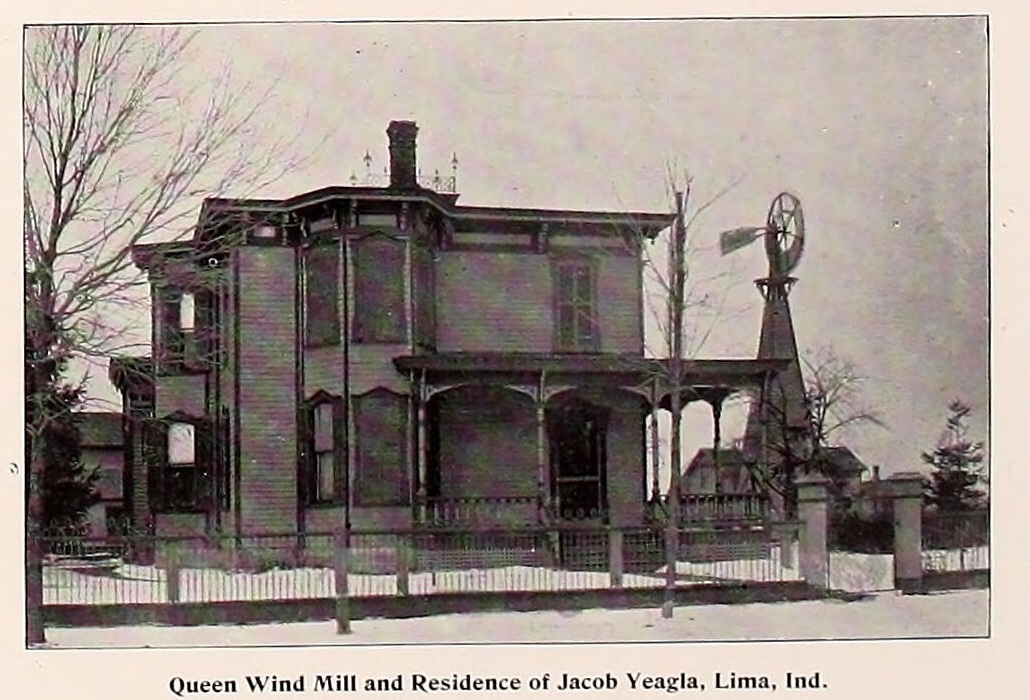
The minnow pail is unread rather than absent. William R. Yeagla patented it on the second of January, 1900. The 1900 volume carries his name in a column of inventions and numbers, and the residence line that would place him in this county was never found. He is here on the strength of a surname that the atlas photographs at Lima, which is not the same thing as evidence.
Six years were read, in eight volumes, and not the whole run. 1871, which the Patent Office printed in three volumes that year, then 1872, 1875, 1885, 1900 and 1912. Whatever this county patented in the forty-odd years between them is not in this piece, and the ten patents above are a floor rather than a total.
Sources
- Annual Report of the Commissioner of Patents, United States Patent Office, 1885. Internet Archive, Smithsonian Libraries scans, Washington, Government Printing Office. Eight volumes read: 1871 in three volumes, 1872, 1875, 1885, 1900 and 1912. Each carries an alphabetical list of patentees under the column head "Name, residence, and invention", which is what makes a search by residence possible. The 1885 volume for Lehmer at Sturgis, the 1872 volume for Lehner at Lima, the 1875 volume for Moon at Wolcottville and Billings at La Grange, the 1885 volume for Chrystler and Drake at La Grange, Rice and Rossman at Ontario and Cookerley at South Milford, the 1900 volume for Collins at Brighton, and the 1912 volume for Ritter at Topeka and Mishler at Shipshewana.
- History of Northeast Indiana: LaGrange, Steuben, Noble and DeKalb Counties. Volume 2, Ira Ford, 1920. Internet Archive. The biographical volume, for the traction engine sentence inside the sketch of Chancy David Stukey, and for the Lehmer family in the sketch of Frederick Smeltzly. The county history proper, in volume 1, contains the name nowhere.
- Counties of LaGrange and Noble, Indiana: Historical and Biographical, F. A. Battey & Co., 1882. Internet Archive. Searched for every patentee named here, and for the Greenfield and Lima township chapters. Also the source for the Moon carriage works at Wolcottville, for Mr. Boyd's hay rack and buggy-top adjuster, and for Drake's patent remedies.
- Illustrated Atlas and Columbian Souvenir of LaGrange County, Indiana, Durant, 1893. Internet Archive, leaf 85, printed page 81. For the photograph of the Queen mill and the Yeagla house at Lima.
The patent volumes are read as scanned text, and the scanning is imperfect in ways that matter here. The 1885 index prints Lehmer as "Xehmer", an X for an L, which is why a search for the name alone finds him in one volume and not another. The alphabetical list gives a name, a residence and an invention but not the patent number, which is printed in a separate numeric table, and the scan of that table drops digits: 162,249 is absent from the 1875 volume while 162,240 through 162,248 survive. Where this piece gives a patent number it comes from the Patent Office record rather than from the annual index, and where it gives a residence it comes from the index.
More from LaGrange County
LaGrange County
The presses did not die
This county had fourteen newspapers before 1882. Most of them died inside two years, and their type went down the road and came out under a different masthead.