Clay Township
Still bearing excellent fruit
Published . Last updated .
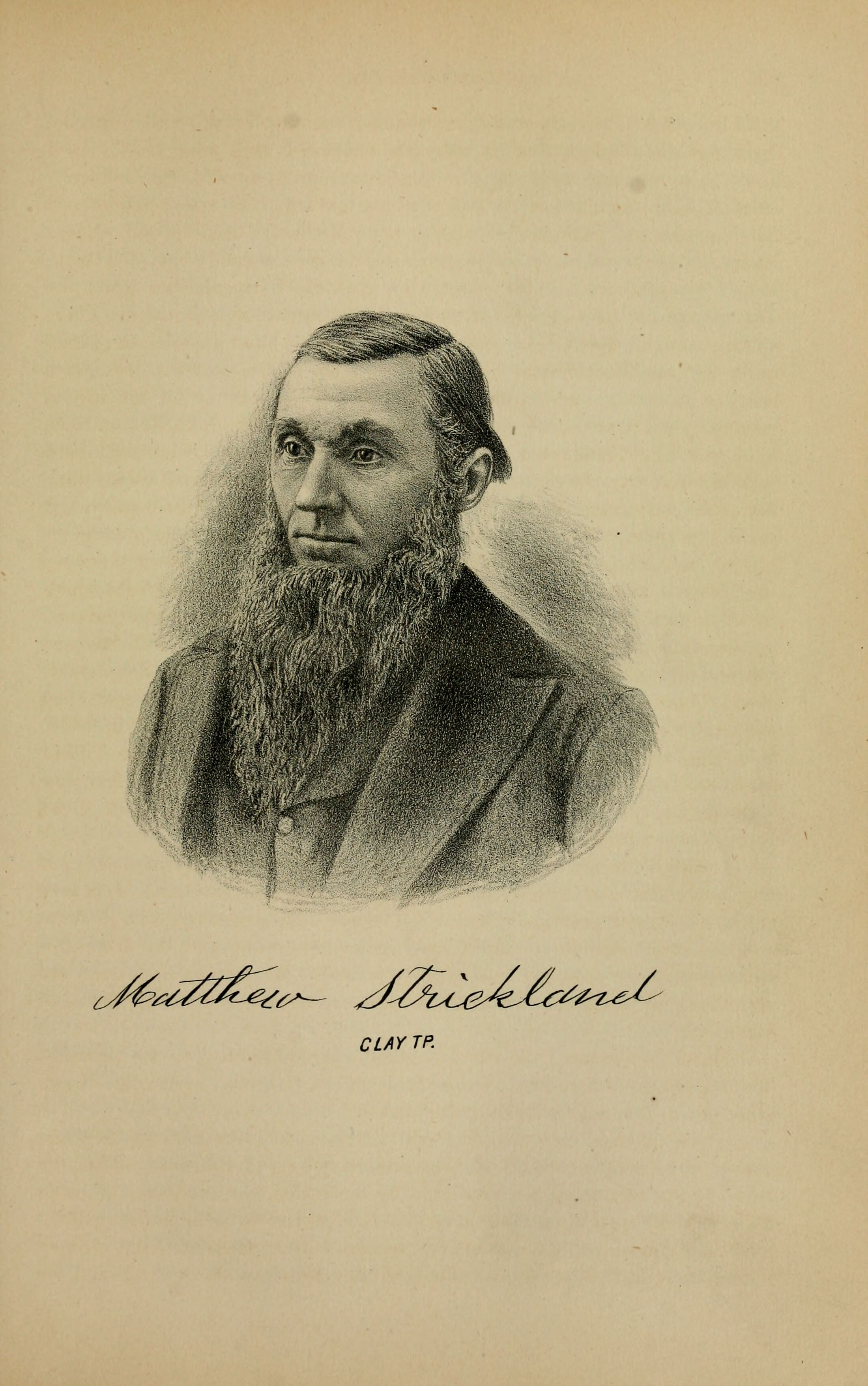
Clay is the township nearest the county seat and the last one anybody settled.
Marsh cut it off from the good ground to the north, and of its thirty-six sections only five or six were worth farming when people started arriving. The county history published in Chicago in 1882 says it still remains behind other townships in wealth and population. The one written by Ira Ford in 1920 says there is no town within its borders, and that Clay Township is without village or store accommodations.
Both books are right and neither has much else to say. There is no piece on this site about Clay Township, because after reading both accounts there was not one to write.
But the 1882 volume carries twenty-one engraved portrait plates, one to a leaf, and one of them is a man from Clay.
Matthew Strickland was born in Ashland County, Ohio, on the third of April, 1825.
He came to this county in February of 1846 with his parents, Mahlon and Martha Strickland, who were both born in 1801, he in Sussex County, New Jersey, and she in Stark County, Ohio. They had eleven children.
His father bought two hundred forty acres in Clearspring Township and another hundred sixty in Clay, and moved the family into a log cabin with what the book calls an elbow-joint fireplace.
In November of 1852 he married Mary Kitchen, who was born in Brant County, Ontario. Her parents had brought her out of Canada to Ohio in 1836 and to Clearspring the year after that. The Kitchens had fourteen children and eight of them were still living when the book went to press.
Since August of 1853, Matthew and Mary Strickland had lived on their farm in Clay Township.
That is nearly all of it, and here is the rest.
They lived thirteen years in a log cabin.
They planted peach seeds in their dooryard, and three years later the trees began to bear.
They planted an orchard in 1857, and twenty-five years on, the county history says it is still bearing excellent fruit.
The farm is now improved well and has substantial buildings.
Both are communicants of the Methodist Church.
Mr. Strickland and wife have no children.
He does not appear anywhere else in that book.
Not in the chapter on Clay Township. Not in the chapter on Clearspring, where he lived for seven years after arriving. Not in any list of officers, or settlers, or subscribers to anything. The county history mentions him in his own biography and in the index of plates, and nowhere else in four hundred and forty pages.
The county history written thirty-eight years later does not mention him at all. It carries other Stricklands, a lumberman at Wolcottville and two lodge officers at the county seat, and nothing connects any of them to him.
So the whole of Matthew Strickland in the published history of this county is one paragraph and one face.
The face is worth looking at, because of what is written under it.
The plates in that book carry a line beneath the signature. Samuel P. Bradford's says COUNTY CLERK. Samuel Shepardson's says COUNTY AUDITOR. Hezekiah Davis's and Sarah Davis's both say NEWBURY TP. John Rerick's says LA GRANGE and O. B. Taylor's says WOLCOTTVILLE.
An office, a township, or a place. Seven of the twenty-four plates have been read and the line does all three.
Whatever chooses between them, it is not whether the man held office. Rerick was county clerk from 1869 to 1877 and Bradford took the office from him in 1877. The same office, one after the other, and one plate names it while the other names a town.
Strickland's says CLAY TP.
He is also the only one of them not wearing a collar and a necktie. Bradford, Shepardson and Davis are all in a white collar with a dark neckcloth. Strickland is in a buttoned dark coat with a broad lapel over a plain dark shirt, and nothing at the throat.
Long face, high forehead, hair combed flat back and long enough to cover the tops of his ears, no moustache, and a very long full beard falling well down his chest in tight crimped waves.
There is one number in the biography that cannot be right. It gives his wife's birth as the fourth of June, 1881, which would have her born twenty-nine years after her own wedding. It is almost certainly 1831, which fits everything else the entry says about her, but the page says 1881 and this is not the place to correct it.
So: a man who arrived at twenty, farmed the poorest township in the county for thirty-six years, married once, lived thirteen years in a log cabin, and joined a church.
He held no office. He built no town. He is in no chapter.
What the record kept is that he put peach seeds in the ground by his door and they came up, and that the orchard he planted in 1857 was still bearing when a man from Chicago came through the county writing everything down.
He and his wife had no children.
Sources
- Counties of LaGrange and Noble, Indiana: Historical and Biographical. Clay Township biographical sketches, the Clay and Clearspring Township chapters, the list of illustrations, and the plate at leaf 261, F.A. Battey & Co., 1882. Internet Archive. The sole source for this piece
- History of Northeast Indiana: LaGrange, Steuben, Noble and DeKalb Counties, volume 1, Ira Ford, 1920. Internet Archive. Cited only for Clay Township having no town within its borders and no village or store accommodations. It does not mention Strickland
This piece rests on a single volume. Everything in it comes from the 1882 county history, and Matthew Strickland appears nowhere in that book beyond his own biography and the index of plates: not in the Clay chapter, not in the Clearspring chapter where he lived for seven years, and in no list of officers or settlers. The 1920 history does not mention him at all. There is no second source to check him against, and this piece does not pretend there is. One figure in the biography is impossible as printed: his wife's birth is given as June 4, 1881, twenty-nine years after their marriage, almost certainly 1831. It is left uncorrected here and the body says so. Text is taken from a scanned original; obvious scanning errors have been corrected silently and no wording has been altered.
Since publication
Correction ·
This piece said the line beneath each portrait gives an office for the men who held one and a township for everybody else. It gives an office, a township or a place, and two of the seven plates now read carry a place. Rerick was county clerk from 1869 to 1877 and Bradford held the same office after him: Bradford's plate names it and Rerick's says LA GRANGE. O. B. Taylor sat two terms in the Indiana House and his says WOLCOTTVILLE. Four plates had been read when this was written and seven have been read now.
More from LaGrange County
LaGrange County
Two windmills from Lima and a traction engine from Sturgis
The 1920 county history remembers Isaac Lehmer as inventor of one of the first traction engines. He patented two windmills from Lima in 1871 and 1872, and the traction gear in 1885 from Sturgis, Michigan. The county kept the memory and lost the man.