LaGrange County
A county that had never seen a soldier
Published .
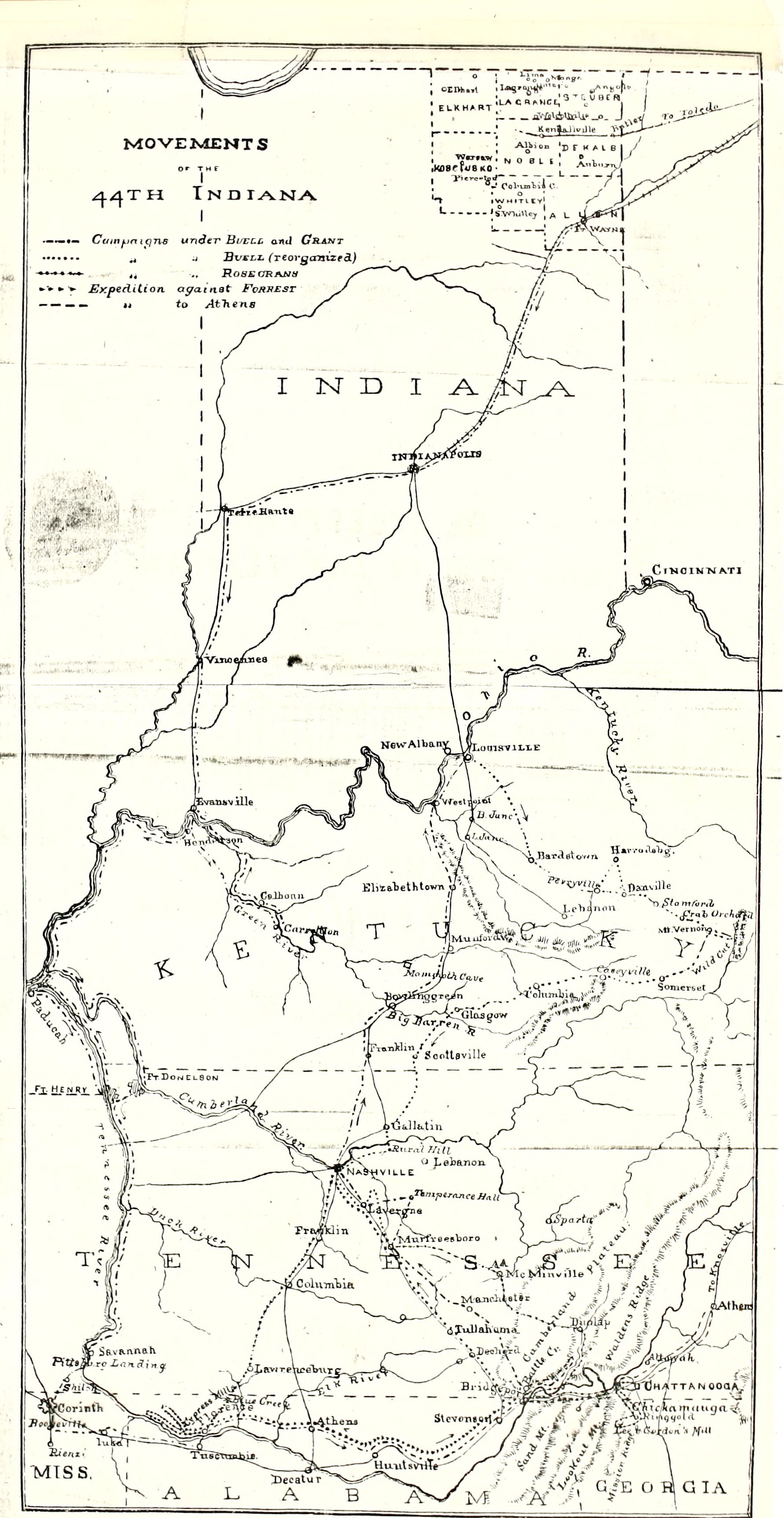
For thirty years nobody here had seen a soldier.
Children were born and grew to manhood without ever seeing a soldier in military dress.
A few veterans of the Revolution had been honoured on Independence Day when the county was new, put on platforms and cheered, and by 1861 all of them were dead. A few men remembered 1812. A handful had gone to Mexico.
Counting every one of them, not ten men in the county had ever smelled gunpowder.
There was exactly one man who could drill a company, and he had learned how in Mexico. William B. Bingham had served in the ranks of an Ohio regiment there, and in the spring of 1861 that made him the most useful man in LaGrange County.
Fort Sumter was fired on in the second week of April. Lincoln called for seventy-five thousand militia on the fifteenth, and Governor Morton called for Indiana's six regiments the next day.
The county's first war meeting filled the courthouse to its utmost capacity.
John Kromer presided, an old citizen and a soldier of 1812. The resolutions passed unanimously. Then the speeches. James Flagg said the tree of liberty must be watered with human blood about once in thirty years and that the time was at hand. Robert Parrett said the only questions now were union or disunion.
Then they called on Andrew Ellison.
Mr. Andrew Ellison was called upon, who, speaking in a candid manner, said his sentiments were not wholly in accord with the previous speakers, but that he was a citizen of the Republic, and acknowledged his allegiance to it, and proposed to stand by its laws under all circumstances and contingencies.
William Boyd said there had been talking enough.
And a doctor named John H. Rerick drew from his pocket an enlistment paper he had already written. It was read, approved, and men began signing it that night.
They called themselves the La Grange Tigers.
Nobody expected a long war.
When public indignation for rebels ran so high as it did then, and a furious and speedy overthrow was anticipated, it was not strange that the most terrific names should be suggested for company titles.
They marched to Sturgis, took the cars to Indianapolis, and found Indiana's quota already full. Thirty of them talked their way into other companies. Twenty-one joined Company B of the Seventeenth Indiana and all but one were credited to Boone County, so this county's first volunteers are on another county's rolls.
The rest came home disheartened. Four of them went to Michigan instead and enlisted there, and one of those four, F. A. Spellman, was killed.
After that the companies went out one after another, and every one of them left carrying something the county's women had made.
Lima raised a hundred and thirty dollars for red flannel shirts and gave the men blankets and clothing besides. When the company marched, the women of Lima presented a flag, and Rebecca Williams made the speech.
Most of it is what you would expect from a flag presentation in 1861. Then this.
Live nobly up to every duty, face bravely every danger, look well that the spirit of true patriotism prompts every action, and never, for one moment, let a thought of petty revenge or cruel hatred dwell in your brave hearts.
She hoped they would come back an unbroken number.
The women of La Grange gave each man a Testament. The next company got a blue woolen Zouave jacket trimmed with velvet, and Captain Bingham a sword bought by subscription. The company after that was fed on A. S. Case's grounds, and the young ladies of the town arranged a hop.
There was no railroad through the county during the war. Every company that rendezvoused at Fort Wayne walked there, or went by wagon, with half the town following as far as Wolcottville or Wright's Corners where somebody had laid on a dinner.
The Ladies' Soldiers' Aid Society organised at La Grange on the first of November, 1861. Four weeks later it reported what it had sent.
two comforts, forty-four pairs of socks, four quilts, four blankets, three sheets, one pair drawers, two pair mittens and forty-two cuts of yarn, and $10 cash
By the summer of 1862 the volunteering had slowed, and the county's own newspaper said what a good many people were thinking.
No more volunteering in La Grange! Let there be a draft as soon as possible!
The argument was fairness. The county had done nobly, but going on this way would do great injustice to a certain class upon whose shoulders a part of the burden must be forced, if they will not carry it willingly.
The machinery went up that autumn. Timothy Fields as draft commissioner, E. P. Spellman as provost marshal, Dr. E. G. White as medical examiner. In September the state told the county what it owed: eight men from Clearspring, seven from Milford, nine from Eden, twenty-two from Van Buren.
Thirty-one men were drafted. Twelve of them bought substitutes.
So the county started buying volunteers instead.
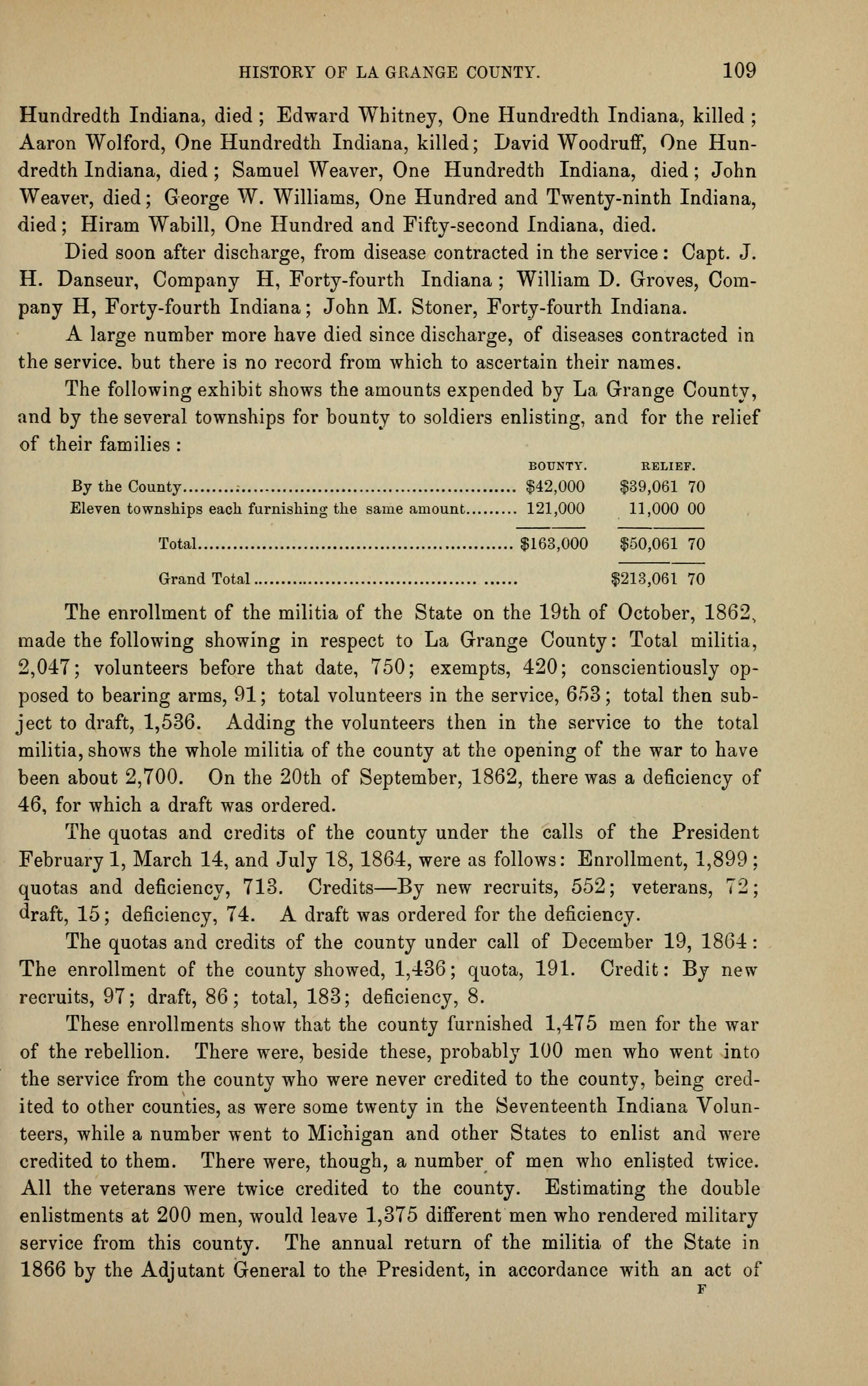
Twenty-five dollars a man in 1862, with a dollar fifty a week for a wife and seventy-five cents for each child until he mustered in. By January of 1865 it was four hundred dollars a man, paid in two installments fourteen and twenty-eight months out, funded by county bonds. The townships raised more on top of that, to induce volunteers and save their own men from the draft.
When it was over the county had spent a hundred and sixty-three thousand dollars on bounty and fifty thousand and sixty-one dollars and seventy cents on relief for soldiers' families.
Two hundred and thirteen thousand dollars, from a county of eleven thousand people.
In one week of February 1863, LaGrange held two mass meetings.
The county had been divided from the first month. At South Milford in May of 1861 the war meeting passed resolutions cooler than anywhere else in the county, and Rerick printed them whole rather than describing them, saying he did it
in order that the different shades of feeling at the time may be represented
Resolved, That we have no sympathy with the Secessionists of the South, nor the Abolitionists of the North, and that we hold them responsible for the present distracted condition of the country.
On the twenty-first, the Union meeting resolved for confiscation of the property of those in armed rebellion and of anyone who gave them aid and comfort, approved the emancipation proclamation as a military necessity and the arming of liberated slaves, and pledged itself in the name of our venerated ancestors to stand by the Constitution and the Union.
On the twenty-eighth, in the same town, the Democratic meeting denounced secession, and then condemned the Federal Government for suspending the habeas corpus, arresting citizens not subject to military duty without warrant or authority, abridging the freedom of speech and of the press, establishing a system of espionage by a secret police, declaring martial law over States not in rebellion, and dismembering Virginia.
John Kromer, who had presided over the county's first war meeting two years earlier, was on the committee that wrote the second set.
Now the number.
The state counted the militia on the nineteenth of October, 1862, and the county's return came back like this. Total militia, 2,047. Volunteers already gone, 750. Exempts, 420. Conscientiously opposed to bearing arms, 91. Total then subject to draft, 1,536.
Ninety-one men.
That is the whole of it. The county's history of the war runs eleven thousand words and it does not say who they were, or what they believed, or what happened to them afterward. It does not use the word Amish, or Mennonite, or Dunker, anywhere.
The man who wrote that chapter also wrote the county's chapter on Newbury Township, where he recorded that the Amish and other German sects had taken up most of it, and that the German Baptists had been meeting there since 1854.
Here they are a number between the exempts and the total subject to draft, and then the arithmetic moves on.
The Roll of Honor runs six pages.
It was compiled from the state Adjutant General's report and it includes only men who were on a muster roll when they died. Each name carries how. Died. Killed. Died of wounds. Missing. Three men are recorded as having died at Andersonville, and a fourth is supposed to have.
Then three men are named who died soon after they came home, and then one line.
A large number more have died since discharge, of diseases contracted in the service, but there is no record from which to ascertain their names.
The county sent about fourteen hundred and seventy-five men to the war, and reckoned that two hundred of those were the same men counted twice, since every veteran who re-enlisted was credited again.
Estimating the double enlistments at 200 men, would leave 1,375 different men who rendered military service from this county.
Thirteen hundred and seventy-five men from a county of eleven thousand.
The doctor who pulled the enlistment paper out of his pocket in April of 1861 went out as assistant surgeon of the Forty-fourth Indiana and came home a major.
Twenty-one years later he wrote the county's history of the war, and he is in it four times: at the first meeting with the paper, on the resolutions committee, enlisting as a private before his commission came, and in the list of the county's officers under Surgeons, rank of Major, on the same page as Samuel P. Bradford, a captain in his own company.
He never once says I.
And he ends on a figure he will not stand behind. The Adjutant General returned the county at 3,030 militia in 1866, more than it had at the war's opening,
if both enrollments were correct
Sources
- Counties of LaGrange and Noble, Indiana: Historical and Biographical, F.A. Battey and Co., 1882. Internet Archive
- The Forty-Fourth Indiana Volunteer Infantry: History of its services in the war of the rebellion, and a personal record of its members, John H. Rerick, 1880. Internet Archive
Every quotation is from Chapter IV of the 1882 county history, signed by Dr. John H. Rerick, and was verified against a scan of the original line by line before publication. Obvious scanning errors have been corrected silently: the chapter reads "a thouglit" for a thought and "year brave hearts" for your brave hearts in the Lima address, and "forty -four pairs of socks" in the aid society's report. No wording has been altered. The chapter sets a space before a closing exclamation mark, which is compositor's practice for the period rather than anything the sense depends on, and that spacing has been normalised here as it is elsewhere on this site. The author of the chapter served as surgeon of the Forty-fourth Indiana in the war he is describing, and appears in his own chapter in the third person four times. The chapter also contains three counts that do not reconcile against its own figures, in the Seventeenth Indiana paragraph, the militia sentence and the Roll of Honor. None of the three is used in this piece. A fourth was listed here and has been withdrawn: the bounty exhibit was read as impossible because the scan flattens a two-column leadered table into a single stream of figures, which makes "eleven townships each furnishing the same amount" look like a claim that eleven shares of $121,000 equal the county's $42,000. The page image below shows the table as it was set, and it reconciles: $121,000 is $11,000 from each of eleven townships, the columns total $163,000 and $50,061.70, and the grand total of $213,061.70 is the sum of both columns printed under one of them. The map at the top of this piece is from a second book, the 1880 regimental history of the Forty-fourth Indiana, written by the same man. It is the only foldout in that volume, it was bound sideways, and the copy shown here has been turned ninety degrees so it reads the right way up. Nothing else was done to it. That volume's public domain status rests on its publication date of 1880 rather than on any rights assertion in the archive record, which carries no rights field at all.
More from LaGrange County
LaGrange County
Two windmills from Lima and a traction engine from Sturgis
The 1920 county history remembers Isaac Lehmer as inventor of one of the first traction engines. He patented two windmills from Lima in 1871 and 1872, and the traction gear in 1885 from Sturgis, Michigan. The county kept the memory and lost the man.