LaGrange
The courthouse they paid cash for
Published .
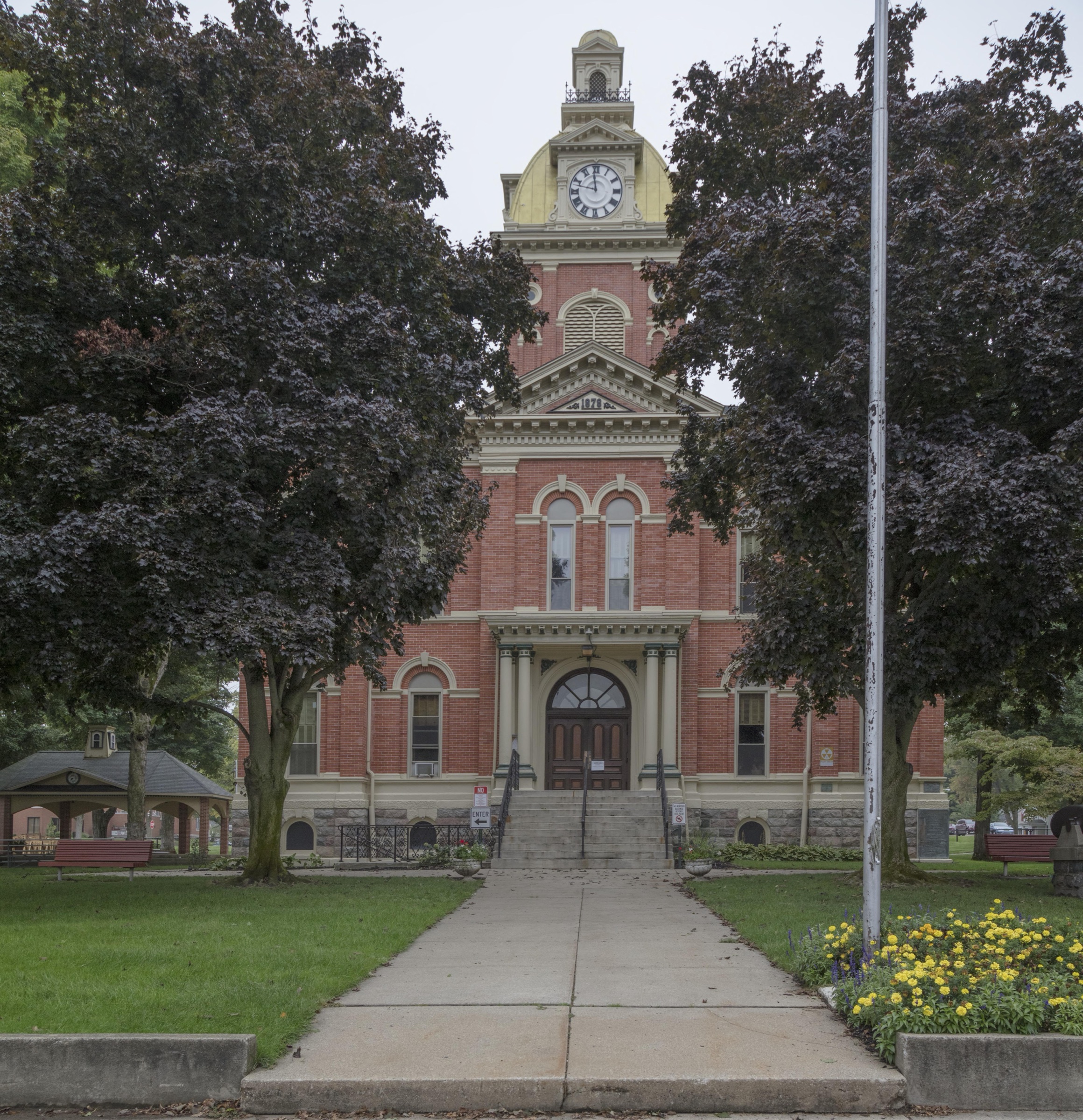
LaGrange County went through two courthouses before this one.
The first went up at Lima in 1833 and lost the county seat out from under it eleven years later. The second went up in LaGrange in 1843. Both were wooden, and the 1882 county history describes them the way you would describe a shed: temporary build, no vaults, no facilities for safety or convenience.
In September of 1877 the commissioners decided on a third.
They hired an architect from Chicago named A. J. Smith. The county history records what happened next in eleven words: a difference arising between him and the commissioners, his engagement was dissolved.
They then hired T. J. Tolan and Son of Fort Wayne, and handed them a plan the county had already drawn up itself. The general outline came from Samuel Shepardson, the auditor, and Samuel P. Bradford, the clerk. Tolan and Son worked out the details and the specifications from there. Bradford has his own piece, and his father is the reason it is worth reading.
Bids were advertised on April 24, 1878. Ten came in, sealed, and were opened together:
W. H. Myers of Fort Wayne, fifty-three thousand. O. D. Hurd of Fort Wayne, forty-eight thousand three hundred sixty-five. Crane, Duncan and Company of Waterloo, fifty-four thousand six hundred ninety. M. D. Brennemen and Company of Huntington, fifty-four thousand five hundred twenty-nine. John L. Farr and Company of Grand Rapids, fifty-eight thousand. J. W. Hinkley of Indianapolis, fifty-nine thousand nine hundred. James E. Shover, fifty-nine thousand seven hundred. R. W. Ostrander and D. O. Porter of Kalamazoo, forty-eight thousand eight hundred ninety-eight and fifty-two cents. Brace, Reed and Ruick of Kendallville and LaGrange, forty-eight thousand seven hundred fifty-eight.
And Charles Bosseker and John Begue of Fort Wayne, at forty-six thousand seven hundred.
Bosseker and Begue were lowest. They put up a thirty thousand dollar bond. The commissioners took it.
Two thousand people came to watch the cornerstone laid on August 15, 1878.
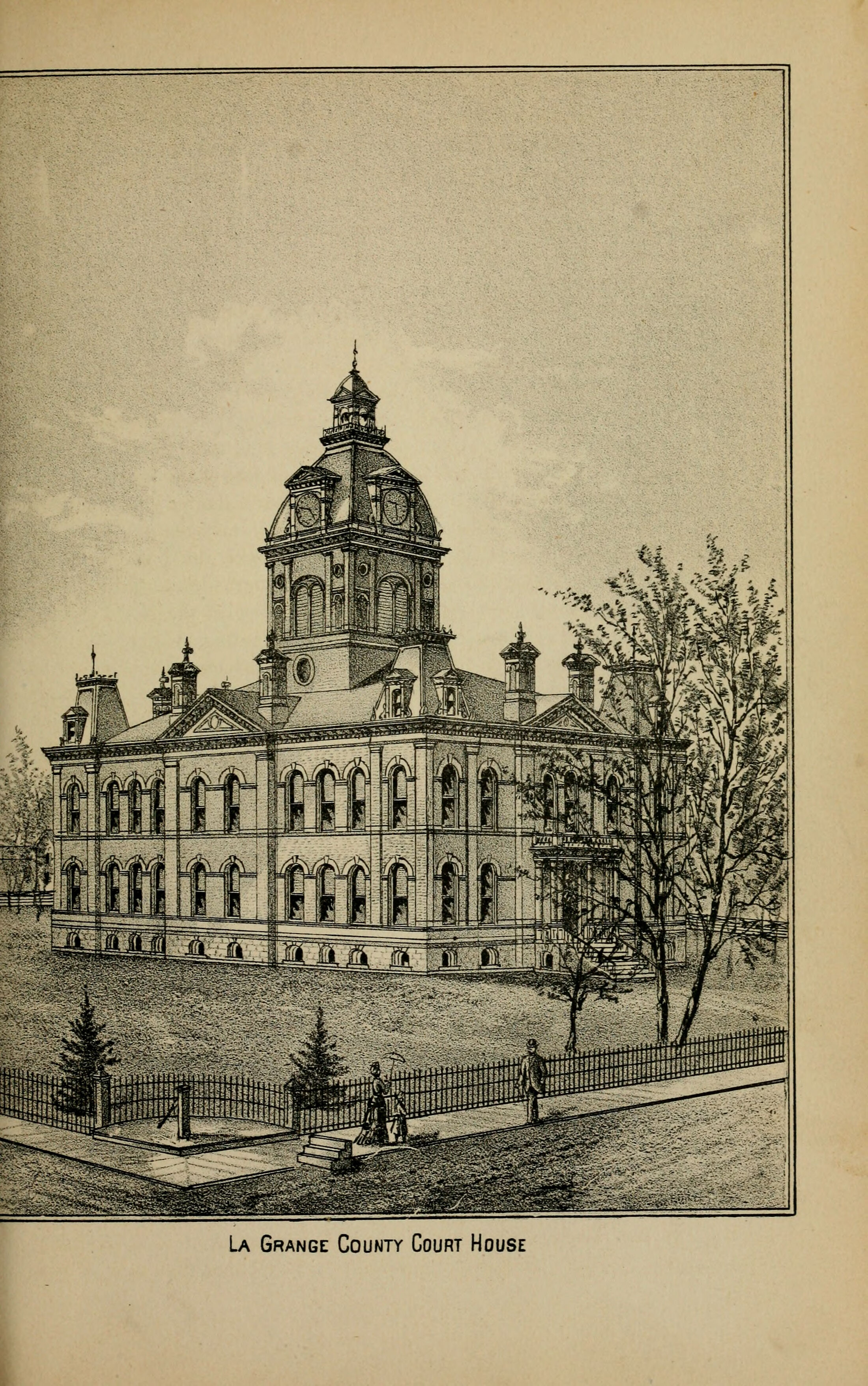
The county history is careful to note that the ceremony was simple, without religious formality or civic display. Short speeches. Odell's Martial Band. The Lima Silver Band. A box placed in the stone, the stone set, and several rounds of cheers.
The Reverend John Paul Jones, who was county recorder at the time, presided.
John B. Howe spoke first. He said he thought he was probably the only person present who had settled in the county as early as 1833, and then asked whether anyone else had, and nearly a dozen hands went up.
He said the changes had been remarkable and the progress almost too rapid. He said the new building would cost as much as the whole county had been worth when he arrived. He said he did not believe in expensive and ornamental courthouses, that they should be like justice itself, simple and unostentatious, but that it was the fashion now and people could not bear to be behind their neighbors. He said he was willing to pay his part and only mentioned the cost as a matter of contrast.
Andrew Ellison spoke next, thirty-six years at the LaGrange bar, and argued that the courthouse was the cornerstone England had built on. Judge William A. Woods spoke after him about who ought to pay for courts, and came down on property rather than persons.
Then they laid the stone.
The copper box that went under it is the best part of the day.
The county put in the 1832 acts containing the law that created it. The bar docket from that April. A county directory. That week's LaGrange Standard and its Centennial issue. The LaGrange Register from that morning. The Wolcottville Gazette from six days earlier. A camp meeting paper called the Daily Service. An insurance application from the Farmers' Rescue Insurance Company. The premium list from the county agricultural society. The school law and the acts of 1877, and a manual of the county's common schools.
Then the odd things. A three cent piece of scrip. Scrip in five, ten, and twenty-five cent denominations from different issues. Two pieces of private scrip. A twenty-five cent silver coin from 1877 and a forty cent silver coin from 1834. A coin dated 1771 and another dated 1774. A Swiss medal. A photograph of a 1775 issue of the New England Chronicle and Gazette.
And six Confederate postage stamps, found in a rebel camp in Virginia.
They also put in the names of the men in the Lima Silver Band, and the names of the officers of the town of LaGrange.
In March of 1879, Bosseker and Begue said they were losing money and becoming financially embarrassed.
The fix was practical and slightly humiliating. Andrew Ellison, the lawyer who had spoken at the cornerstone, was appointed to act as the contractors' agent and handle the money coming in and going out on their behalf. The commissioners took over hiring the labor and buying the materials that were not already under subcontract. The county agreed to pay whatever the finish cost above the contract price.
The work started again. The county took possession on November 13, 1879.
What they got was sixty-four feet eight inches by one hundred feet eight inches, two stories over a basement, with a tower running up through the middle of the building to a finial one hundred twenty-five feet above grade.
The footing stones are limestone, six to ten feet wide, laid in a floating coat of mortar on concrete. The foundation walls are split boulder stone. The pressed brick on the outside came from Porter Station, Indiana, and was laid in putty mortar with a smooth pointed joint. The common brick inside came mostly from Fort Wayne and partly from this county. The sills and caps are cut limestone from Joliet, Illinois. The beams and trusses and rafters are wrought iron and the ceilings are corrugated iron.
The roof is black slate, fourteen inches by two feet, nailed with copper nails.
The floors are oak, and the main halls are black and white marble tile. The finish work runs walnut and ash, alternating. The vaults are fireproof and the county history says so flatly, without the qualification it gives the rest of the building.
Water came from a windmill tank on the jail lot next door. The building was constructed for furnace heating and heated with stoves.
The accounting is in the auditor's 1880 annual statement.
Miscellaneous expenses, three thousand eight hundred thirty dollars and one cent. Extra sub-foundation, nine hundred sixty-six eighty-five. Tolan and Son, eleven hundred forty-four. The commissioners, two hundred thirty-three fifty for extra sessions. Bosseker and Begue, forty-seven thousand four hundred forty-five thirty. Paid in excess of contract, seven thousand eight hundred seventy-nine.
Sixty-one thousand four hundred ninety-eight dollars and sixty-six cents.
Then the tower clock and bell at fifteen hundred seventeen forty-five. Furniture, three thousand seven hundred thirty-five and seven cents. The west part of the square, bought outright, four thousand one hundred twenty-seven thirteen. Grading the yard, seven hundred ninety-seven and one cent.
Seventy-one thousand six hundred seventy-five dollars and thirty-two cents. An iron fence went around the square the next season for about twenty-five hundred more.
The 1882 history closes the subject in one sentence. The whole was paid for as fast as the work was done, and the county neither borrowed nor owed a dollar after its completion.
The commissioners who signed for it were Hezekiah Davis, Alanson Blackmun, and George W. Edgcomb. Their names are cut into the north face of the cornerstone, under the county's, along with the auditor's, the architects', the local superintendent's, and the contractors'.
The line below theirs reads "Completed," then a blank where the year should be. They cut the stone before they knew it.
The building was added to the National Register of Historic Places on July 17, 1980. It is still the county courthouse.
Sources
- Counties of LaGrange and Noble, Indiana: Historical and Biographical, F.A. Battey and Co., 1882. Internet Archive
- National Register of Historic Places listing, LaGrange County Courthouse, 1980. National Register reference 80000042, added July 17, 1980
Figures and quotations from the 1882 county history are taken from a scanned original. Obvious scanning errors have been corrected silently. No wording has been altered.
More from LaGrange
LaGrange
The building went to the carriage works
The county seat ran out of money before the roof was on. The shell was finished by a church, failed, sold to a man, traded to a railroad, and hauled down the Haw Patch road to be a carriage factory. Eight years later the town built a school for thirty thousand dollars.