Brighton
The non-resistant's son
Published .
Samuel Bradford was born in Hillsboro County, New Hampshire, on the twentieth of December, 1800.
His father moved the family to New York and died there in 1808, leaving a wife, three sons and four daughters. The county history published in 1882 sums up the boy's education in one clause. Three months' attendance, having been constantly employed in duties common to pioneer life.
By 1820 he was a minister, and one of four men who established a branch of the first Free-Will Baptist church in what became Monroe County, New York.
He married Betsey Compton in Bradford County, Pennsylvania, in the spring of 1825.
The next day he left his bride and started for Ohio, where he stayed a year, looking after the interests of his church across seven counties.
They came to LaGrange County in the spring of 1831.
He pre-empted land in Greenfield Township, put up a log cabin, went back to Ohio in the fall, and brought his family out. He sold that place in 1833 and moved to Springfield.
There he built the first saw mill in the county, on Turkey Creek about a mile from its mouth, with a race half a mile long that he doubted would carry enough water. It ran anyway, and it was still running fifty years later. He added a carding mill and sold both in 1836.
In 1837 he moved back to Greenfield, onto Samuel Brown's farm, and held school in his own house. It was among the first schooling in the township.
And around that time, the county history says, he left the church he had spent seventeen years in.
He withdrew from the Free-Will Baptists having adopted the non-resistant and anti-slavery principles, and formed the society at Lexington known as the Congregation of Saints.
That society wrote its preamble in March of 1843 and had it printed in the LaGrange Freeman.
They declared themselves deeply sensible of the innumerable evils afflicting all classes of society, and said they despaired of deliverance through the present social and political systems, which they believed were at variance with the principles of Christianity.
They proposed to buy and farm somewhere between two and six thousand acres. They proposed to make provision for the aged and the afflicted. And they wrote down three things they intended to do. Abolish the distinction of master and servant. Preserve individuality. Secure the rights and extend the privileges of women.
The newspaper that printed it said the matter looked dark to them.
The society hardly got organised before disorganisation commenced. Its preamble and what became of it are told from the Springfield side in one hundred twenty people at the same table, which was written before the biography linked the two names.
Bradford did not stop. He helped organise the LaGrange Industrial Association, and when he died he was a member of the LaGrange Phalanx, the Fourierist community where a hundred and twenty people lived under one roof on Benjamin Jones's farm.
He died on the third of December, 1845.
The county history records that his congregation put up a monument to him, and prints what they had cut on it.
Brother, in thee Society no common loss sustained, For thou wast to humanity a warm and faithful friend. Thy life, thy nobler powers, with an unsparing hand to God and man thou didst devote, And all thou hadst and all thou was thou gavest to promote.
His widow Betsey lived another eleven years. The county history says she bravely shared the privations of pioneer life, and after his death carried out the principles he had inculcated in the minds of their children.
Of the four children, three are buried in the village cemetery at Lexington. William C. is buried on the north side of Pretty Prairie.
Samuel P. Bradford was twelve years old when his father died.
He was born on English Prairie in Greenfield Township on the eleventh of April, 1832, and by his own account he was the oldest white person born in LaGrange County still living in it, a claim the county history repeats in his biography and openly disputes in its Greenfield chapter, where it says some dispute has arisen over this mooted question.
After his father died he farmed, taught school, worked at carpentering, and clerked in a store in Fort Wayne. The 1882 history names him among the men who taught in the county seat's district schools before it had a graded one. He came home and lived with his mother until she died in 1856, then farmed in Milford Township.
On the twenty-second of September, 1861, he enlisted as a private in Company H of the Forty-fourth Indiana Volunteer Infantry.
The son of the man who withdrew from his church over non-resistance went to war sixteen years after his father was buried.
He was made regimental quartermaster after Corinth, and commissioned to it in January of 1863.
The county history lists where he went with the command, and the list is the war in the west. Corinth to Battle Creek, Louisville, Nashville, Murfreesboro, McMinnville, Jasper, Bridgeport, Chickamauga, Chattanooga.
In the autumn of 1864 he was assigned to General Steadman's staff as chief quartermaster of the District of the Etowah. In January of 1865 he was commissioned captain of his old company, and stayed on the staff until October.
His regiment was mustered out in September of 1865 while he was still on detached service. He was relieved from duty and drew no pay after November.
He was not finally mustered out until 1868, by special order of General Grant.
He came back to LaGrange County in 1870 and was elected county clerk in 1877.
The following year the commissioners decided to build a new courthouse. They had already hired an architect from Chicago and fallen out with him. What they used instead was a plan drawn up by two of their own officers: Samuel Shepardson, the auditor, and Samuel P. Bradford, the clerk.
Bradford was made local superintendent of the work, and the county history says his duty was faithfully to enforce all the terms.
The building cost seventy-five thousand dollars and the county did not owe a dollar on it when it opened in November of 1879. How it was paid for is its own piece.
The commissioners also directed him to sort out the clerk's records, which were in bad condition. He arranged and indexed them, and the county history says the result was pronounced the most complete system in the state.
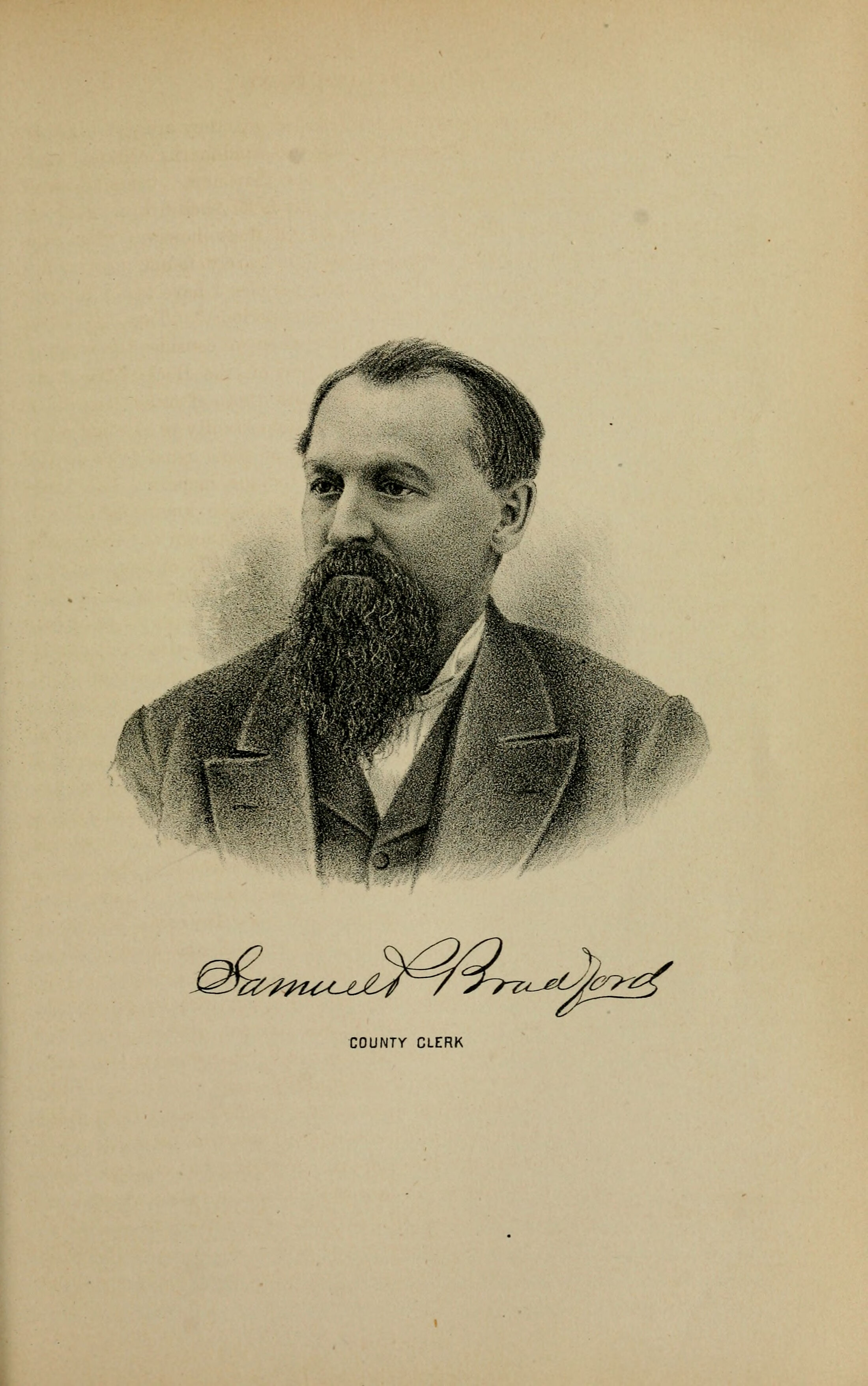
There is a portrait of him in the 1882 county history, engraved on its own leaf, signed beneath in a large looping hand. Under the signature, in small spaced capitals, it says COUNTY CLERK.
There is no portrait of his father in that book, or in any other.
The man who wanted to abolish the distinction between master and servant has one verse on a stone in Lexington, paid for by the people who agreed with him. His son has a plate in a subscription county history, and a courthouse.
Sources
- Counties of LaGrange and Noble, Indiana: Historical and Biographical. Town of LaGrange biographical sketches, the Greenfield and Springfield Township chapters, Chapter III, and the county organization chapter, F.A. Battey & Co., 1882. Internet Archive. Carries both biographies, the Congregation of Saints and its preamble, the monument inscription, the courthouse plan, and the plate at leaf 31
- History of Northeast Indiana: LaGrange, Steuben, Noble and DeKalb Counties. Volume 1, the courthouse and Springfield material; volume 2, the references inside other entries, Ira Ford, 1920. Internet Archive. HE CARRIES NOTHING ABOUT BRADFORD THAT BATTEY DOES NOT, AND AN EARLIER VERSION OF THIS NOTE CLAIMED OTHERWISE. It said Ford calls him a soldier in the war for the Union and clerk of the LaGrange Circuit Court. Ford does neither. Checked on 20 August 2026: he mentions Samuel P. Bradford exactly twice, in the courthouse plan passage and in a list of attorneys practising in 1882, and both compress Battey. Nothing in either is about war service. The phrase war for the Union does appear twice in Ford and both times it is somewhere else entirely, on the Standard's ownership and on wartime paper money. HIS WAR SERVICE RESTS ON BATTEY ALONE, in three places: the officer list and the quartermaster list in the war chapter, and his own sketch, which carries the enlistment date, the appointment after Corinth, the campaign list, the Etowah staff post and the captaincy. Every one of those in the body of this piece is Battey's. HE IS ALSO NOT A SECOND SOURCE ON THE COURTHOUSE PLAN. Checked on 20 August 2026: Ford's account of it compresses Battey's, naming the same two officers, the same architects T. J. Tolan and Son of Fort Wayne, and the same 24 April date for the bids. It is 1878 material and the standing rule covers it. Ford also runs the two offices together where Battey keeps them apart, giving Shepardson as auditor and Bradford as clerk, so where the two differ Battey is the one to follow
Battey contradicts itself twice on this family and the piece does not paper over either. On the death of Samuel Bradford, his biography gives December 3, 1845, while the Greenfield Township chapter gives 1844; the son's entry says he was twelve when his father died and he was born in April 1832, which fits either. The body follows the biography, as the more specific of the two. On the saw mill, the biography gives 1834, while the Springfield Township chapter gives 1833 and adds that George Thompson, who dug the race, said it did not run until the spring of 1834; the body dates the mill to no year at all. Quotations and figures are taken from a scanned original. Obvious scanning errors have been corrected silently. No wording has been altered.