Clearspring Township
The Zook self-opening gate
Published .
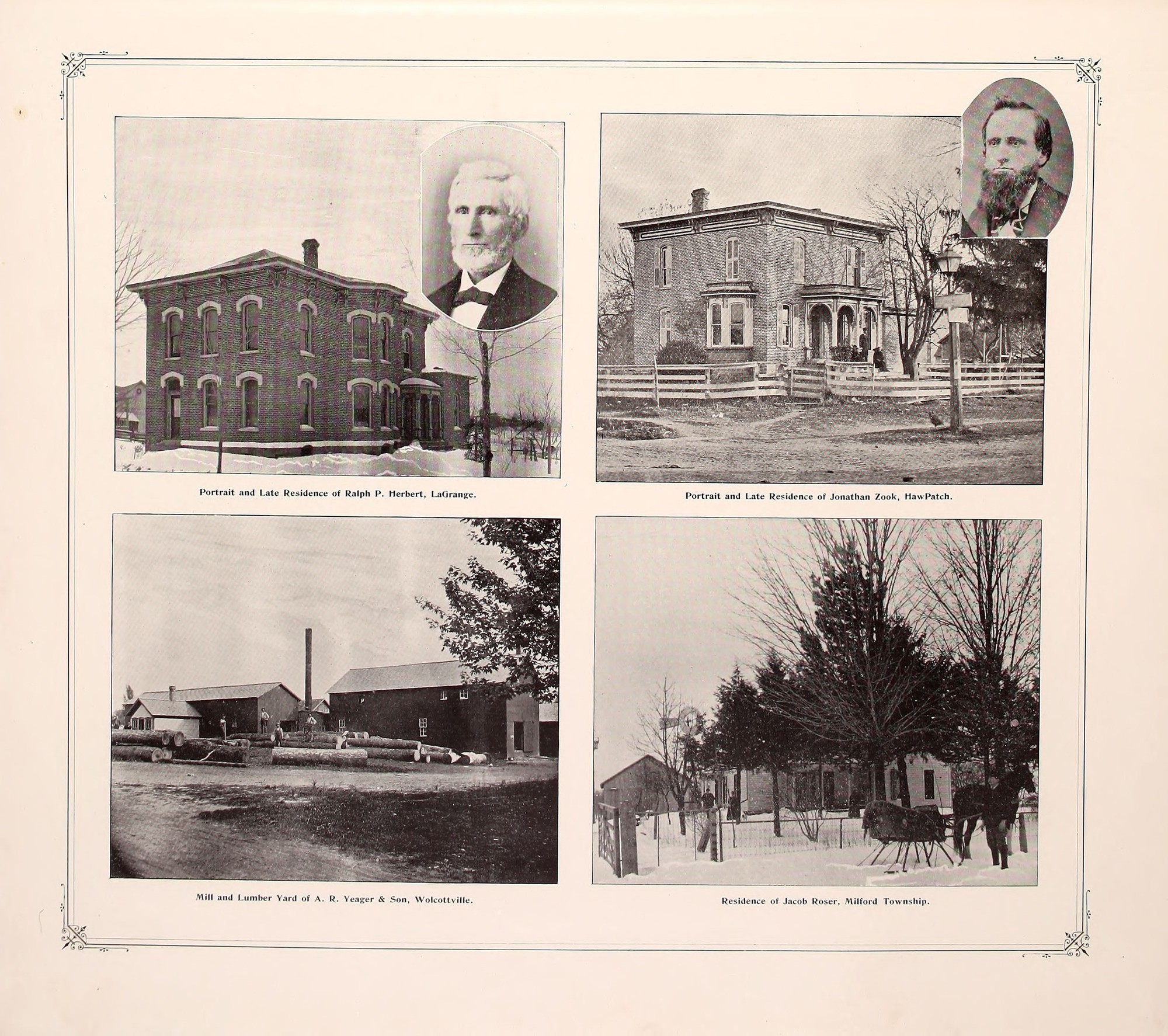
In 1893 the county atlas printed a photograph of a brick house at Hawpatch, with an oval portrait of a bearded man set into the corner of it. The caption reads Portrait and Late Residence of Jonathan Zook, HawPatch.
Late meant he was dead. The atlas gave him a paragraph, and in the middle of the paragraph it gave a gate one sentence.
In 1883 he invented the Zook self-opening gate, which he manufactured several years.
No other history of this county names the invention. The 1882 history does not name him in full at all, and the 1920 history names him nowhere.
The government recorded it, and got the place wrong.
Every year the Patent Office printed an alphabetical list of the people it had granted patents to, with a residence beside each name. Near the end of the list for 1883:
Zook, Jonathan, Hanpatch, Ind. Gate
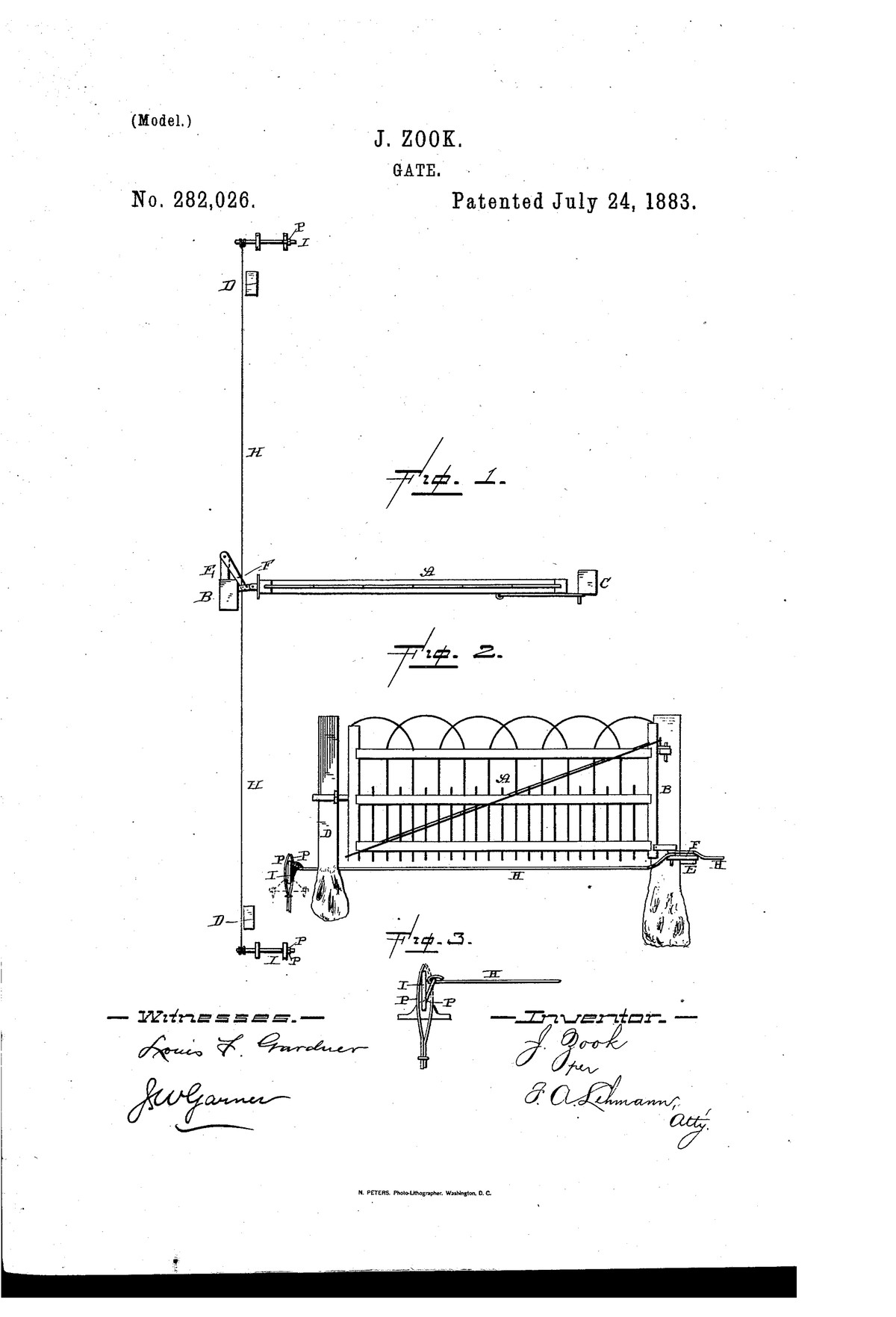
The village was Hawpatch. The patent itself, number 282,026, dated the twenty-fourth of July, 1883, carries the same spelling in its heading and again in its opening sentence.
Be it known that I, Jonathan Zook, of Hanpatch, in the county of Lagrange and State of Indiana, have invented certain new and useful Improvements in Gates
The atlas called it a self-opening gate. The patent calls it a gate.
The application was filed on the twenty-first of February, 1883. The gate hung from a fixed hinge at its upper corner. Its lower corner rode on a swinging link, and rods ran from that link out to a crank on either side of the gate.
When the cranks are operated by the wheel of the vehicle, the rod connected to the crank pushes the lower bearing of the gate by means of the swinging link upward to one side, thereby inclining the gate in such a manner as to cause it to unlatch and to swing open.
Springs on each side of a crank held it upright.
After the wheels of the vehicle have passed over the crank it immediately rises into position again, and is again ready to be operated.
Jonathan Zook was born in Lancaster County, Pennsylvania, on the ninth of February, 1838. In 1865 he bought a farm of a hundred acres in Noble County, and the next year he married Lydia E., daughter of Solomon Lantz. The atlas says he was always interested in machinery, and that for a number of years he was the agent for wind wheels at Hawpatch.
In 1881 he built a brick house there and a store building. The atlas adds that at that time there were only a few buildings in the village, which the 1882 history called Slabtown.
That history records a building there in the same year.
A large harness shop and fine brick residence were erected, in 1881, by J. Zook, on the Clearspring side, at the place of the old Hudson store.
It gives an initial and not a name. What joins J. Zook to Jonathan is that initial, the year 1881, and a brick building in the same village, against a harness shop in one book where the other has a store building. That is the whole of it, and neither book makes the connection.
The patent was granted in July 1883. The atlas puts one more thing in that year.
In 1883 his health failed him and he never regained it.
He died on the twenty-third of September, 1891.
Sources
- Letters Patent No. 282,026, Jonathan Zook, Gate, United States Patent Office, 1883. Specification and one sheet of drawings, application filed February 21, 1883, patent dated July 24, 1883. Read from the two page image at patentimages.storage.googleapis.com, rendered with PDFKit.
- Annual Report of the Commissioner of Patents, United States Patent Office, 1883. Internet Archive, Smithsonian Libraries scan, annualreportofco1883unit. Printed as the Index of Patents Issued from the U. S. Patent Office, 1883. The Alphabetical list of patentees, leaf 380, printed page 366, for the Zook entry with its residence, number and date.
- Illustrated Atlas and Columbian Souvenir of LaGrange County, Indiana, Durant, 1893. Internet Archive, historicalatlaslagr00dura. Leaf 120 for the biography of Jonathan Zook, leaf 93, printed page 88, for the plate, and leaf 11 for the illustrations index entry.
- Counties of LaGrange and Noble, Indiana: Historical and Biographical, F. A. Battey & Co., 1882. Internet Archive, countiesoflagran00infaba. The Eden Township chapter, for the 1881 harness shop and brick residence erected by J. Zook at Slabtown.
- History of Northeast Indiana: LaGrange, Steuben, Noble and DeKalb Counties, Ira Ford, 1920. Internet Archive, historyofnorthea11ford and historyofnorthea02ford. Both volumes searched; neither names Jonathan Zook or the gate.
The atlas and the county histories are read as scanned text, and obvious scanning errors in quoted passages have been corrected silently with no wording changed. That matters here: the scan of the atlas gives the year of the gate as 1863, and the printed page reads 1883, so every date in this piece was read off the page image rather than the text. Hanpatch is not a scanning error. The Patent Office printed it, in its annual index and in the patent.
Correction
This piece called Slabtown a crossroads. No source describes it that way. The 1882 county history calls it a village, and the sentence now says only that it called the village Slabtown.
More from LaGrange County
LaGrange County
The presses did not die
This county had fourteen newspapers before 1882. Most of them died inside two years, and their type went down the road and came out under a different masthead.