LaGrange
What the county seat gained and lost
Published .
Starting in 1901, the Sanborn Map Company printed an index on the first sheet of every LaGrange edition. It lists the streets, and then it lists what the company called specials: the buildings in town important enough to name.
Nobody made that list to be read as history. It exists so an underwriter could find the canning factory without hunting seven sheets.
Read the 1901 list against the 1910 list and you get nine years of a county seat, in about fifty words.
Here is what was on the 1901 list and gone by 1910.
Hotel Oliver. The Galloway Ho. Ellison Pure Cream Station. H. H. Smith's elevator. The La Grange Mills. The Episcopal church. The United Brethren church. And the saw mill half of P. N. Stroup and Company, which by 1910 is a planing mill and nothing else.
Here is what was not on the 1901 list and is on the 1910 one.
A fire department hose house. A post office. A telephone exchange. A Masonic hall. The Lutz and Schramm pickle factory. W. W. Murry's ice and ice cream factory. The Home Grain Company. The Syke Milling Company. Mount Zion Evangelical Lutheran church. The Cottage Hotel. The Herendeen Inn. And the St. Joseph Valley Railroad shops.
A town that adds a telephone exchange and a fire station in nine years, and loses two churches and a hotel.
The Herendeen Inn is the Hotel Oliver. Same building, same thirty-two feet of frontage, new name.
Next door to it, at building 161, is Ruick's Opera House, and it does not move at all.
It is not on the 1883 sheet. In 1887 the surveyor drew it without a name and lettered Stage Scenery and Footlights on it. By 1892 it is Roicks Opera Ho. By 1901 it has picked up an apostrophe and become Ruick's, twenty-six feet of frontage, brick, one storey built to the height of two, with the stage and scenery across the north end and a dashed arc drawn through the auditorium for the gallery.
The 1910 sheet is identical in every measurable particular. Same twenty-six feet, same brick, same stage, same gallery arc.
The hotel next door changed hands and changed names. The opera house did not change at all.
The other thing that did not change is the courthouse, and the sheets show it acquiring a century.
In 1883 it is a plain outline on an otherwise empty public square, drawn in pink for brick, with a small square at the centre for the tower and a well marked at the southeast corner. In 1887 it is marked 2 and B, two storeys and a basement, with a corridor drawn in.
By 1901 the surveyor has lettered it properly. La Grange County Court House. Tile floors. Chimneys, iron columns. Heat, hot water. Lights, electric.
By 1910 it reads corrugated iron ceilings, and the tower is labelled CLOCK TOWER.
That is a building being wired for electricity in the margins of a fire insurance map, twenty-two years after two thousand people watched its cornerstone laid.
Now the printing offices.
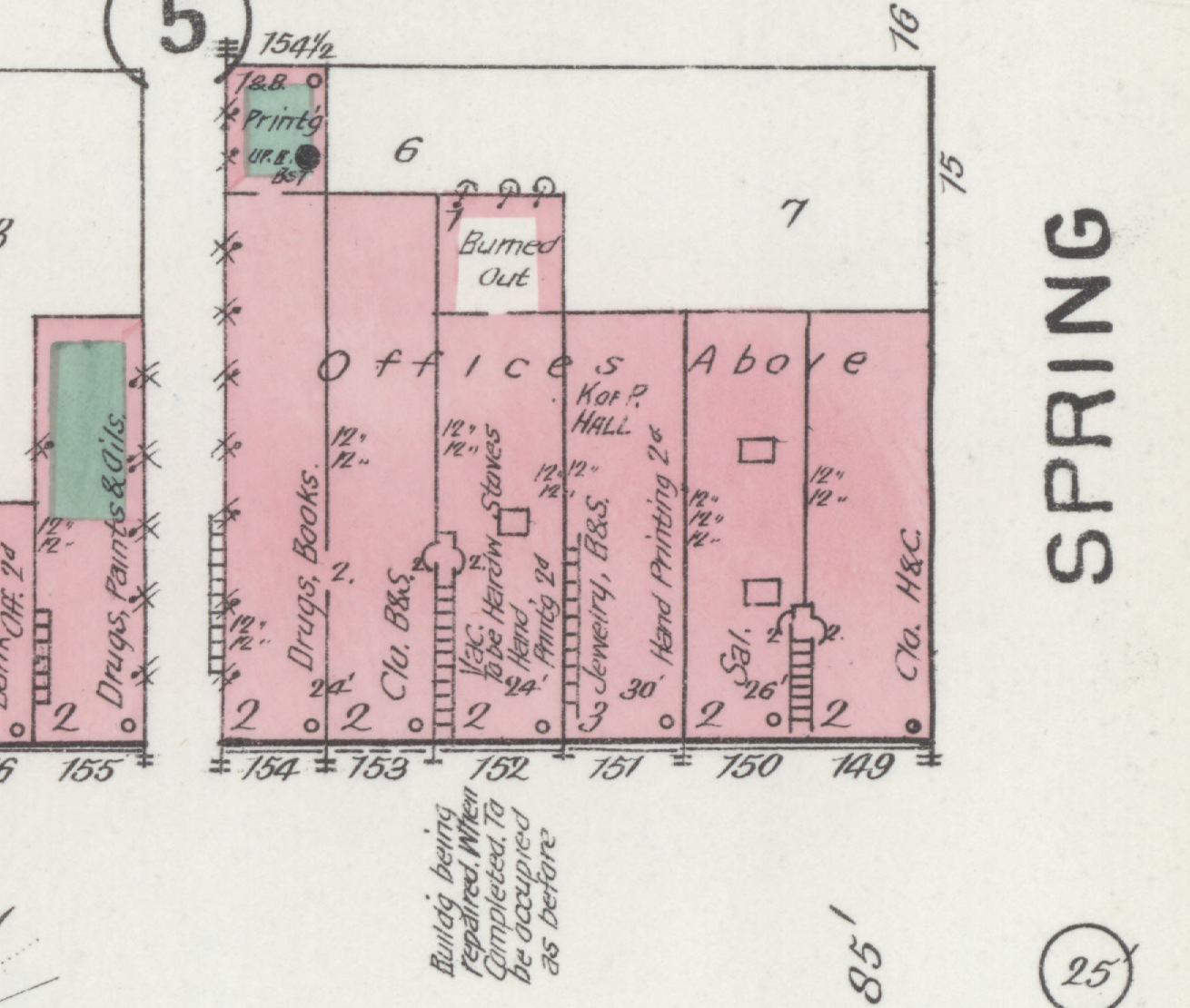
In 1883 there were three on the block east of the square, and all three are drawn in green, which is Sanborn's colour for a special hazard.
One sits on the second floor over a dry goods store at 155. One sits on the second floor over a hardware store at 152. The third has a building to itself, a storey and a half on the corner at 154½, and the surveyor lettered it Print'g Bas't with Upr. Boiler Bas't. A printing office with a boiler in the basement.
By 1887 there are two, and the colour has changed. Only 154½ is still green. The other, at 152, is lettered Hand Print'g and drawn in plain pink like every other storefront on the row.
That is the difference between a press turned by hand and a press turned by steam. The hand presses stopped being treated as dangerous. The one with the boiler never did.
In 1892 there are three again. The green one at 154½ with its boiler, unchanged. Hand Print'g 2d at 152. And Hand Printing 2d at 151, over a jeweller and a bootmaker, beneath the Knights of Pythias hall.
That same year, behind the block, the surveyor drew a small unshaded rectangle interrupting the brick and lettered it in two words.
Burned Out.
Its edges line up with the party walls on either side of 152.
So 152 carries four separate marks on one sheet. The rear of it is burned out. The unit is lettered Vac. It is To be Hardw. Stoves. And upstairs it still reads Hand Print'g 2d.
In the street below, the surveyor added a note. Build'g being repaired. When Completed. To be occupied as before.
The 1892 sheet caught that building mid-repair, with a printing office still lettered on the floor above the damage and a hardware store already planned for the ground.
By 1901 there is no printing office anywhere on the block, and there is no 154½ either. The corner where the building with the boiler stood carries no structure and no number.
What is at the rear instead is a tin shop drawn in green, an ice house, an oven, and the Odd Fellows upstairs. By 1910 the tin shop is drawn in pink and a warehouse has appeared.
Three printing offices in 1883, in a town the map says held two thousand people. Two in 1887. Three again in 1892, one of them over a fire. None in 1901. None in 1910.
The boiler was two doors along from the building that burned. The maps say nothing about whether that mattered, and neither will this.
The fire story runs the other way.
In 1883 the town has no engine of any kind, no independent hose carts, and water facilities the surveyor summed up as not good. In 1887, still nothing, and someone wrote Bucket Brigade in the box. In 1892, still not good.
Then the 1901 cartouche stops saying it. The town has two independent hose carts, and the index carries a water works, listed under L for La Grange, on sheet 3.
The building is there: brick, on the railroad side of the block, two storeys at the street and one behind, with two black rectangles inside for boilers and two double circles for fire pumps. Beside it the surveyor lettered the name and, on the second floor, Council R'm.
The town council met above the water works.
By 1910 the same building is dimensioned, the fire pumps are labelled, a ten inch water pipe runs down the street outside, and there is a hydrant on the corner. The second floor is no longer a council room. It is lettered Store Room.
The 1910 cartouche gives the town five six-inch wells a hundred fifteen feet deep, two Gordon steam pumps, five miles of mains laid in 1893 and 1910, fifty-three hydrants, and forty-five volunteer firemen. The alarm is a whistle at the water works plant. Wolcottville, on the same five-edition run, has no water works building until 1914 and is still lettered see note in 1922.
And on Lafayette Street there is now a brick building, one storey, twenty feet across, with its contents lettered vertically inside it:
2 hose carts and 1 ladder wagon. 2100 feet of two and a half inch cotton rubber lined hose.
That is the cartouche copied into the building. The surveyor wrote the same inventory twice on the same visit, once as a summary and once where the hose actually hung. In 1901 that lot was open ground with a few frame sheds on it.
None of this was written down by anyone who lived here.
The county history published in 1882 and the one Ira Ford wrote in 1920 both cover LaGrange at length, and neither one tells you that the council met above the water works, or that the opera house never moved while the hotel next door changed names, or that a town of two thousand had two printing offices and then had none.
It is on five insurance maps, made by a company in New York, by men who came to town to work out what it would cost if it burned.
Sources
- Sanborn Fire Insurance Map from Lagrange, LaGrange County, Indiana. Five editions: October 1883, November 1887, November 1892, March 1901, August 1910, Sanborn Map Company, 1910. Library of Congress, Geography and Map Division. Carries every figure, name and annotation in this piece
The five Sanborn editions used here are one source series rather than five sources. They are the work of a single company returning to the same town, so agreement between them is one method repeated rather than corroboration. They are treated as documented because they are primary business records made on the ground for money, not a narrative written afterwards. Names of businesses and institutions are transcribed from the printed indexes on the first sheet of the 1901 and 1910 editions, and lettering is transcribed from the sheets as drawn, including abbreviations. Names on these lists are not stable across editions: Fitzgibbon & Co., M'f'rs of Oars in 1901 is Fitzgibbons & Co., Oar M'f'g in 1910, the same firm with a different spelling and a different phrasing. A changed name here does not mean a changed business.
More from LaGrange
LaGrange
The building went to the carriage works
The county seat ran out of money before the roof was on. The shell was finished by a church, failed, sold to a man, traded to a railroad, and hauled down the Haw Patch road to be a carriage factory. Eight years later the town built a school for thirty thousand dollars.