LaGrange
The building went to the carriage works
The first school in LaGrange was taught by Laura Brown in a barn. That was ordinary; the county's schools began in barns, log rooms and whatever building stood empty.
The county history published in 1882 puts it just north of where the American Hotel used to stand, or across from it, northeast of the Central Hotel. She later married a doctor named Butler.
That is the whole of what the book says about the first opportunity offered, in its phrase, to the little urchins of the village.
For the next twenty-odd years there were district schools. Two of the men who taught in them turn up elsewhere in the county's record: Samuel P. Bradford, who by 1882 was clerk of the circuit court, and a Reverend Welch, who became a presiding elder in the Methodist conference.
The town wanted more than that, and there was a law for it.
Indiana provided for county seminaries, funded from designated sources, and LaGrange gathered the money and began building. A two-story frame structure, a few rods south of where the school stands now.
They got it enclosed.
Then the money ran out, and the work stopped, and the building sat there.
The Methodist Episcopal Church bought the shell and finished it.
School opened in the autumn of 1850 under James C. McIntosh of Connersville, a graduate of Asbury. He gave it a year of highly acceptable service and went home.
Robert Parrott came next, also from Asbury. He taught a year and then left to practise law. When the war came he went into the army and was commissioned major of the One Hundredth Indiana. He was killed near Vicksburg, in his tent, by a tree that came down in a storm.
Isaac Mahuren followed Parrott and lasted a few months. Then John Paul Jones took the rest of the term and resigned, because he had been elected clerk of the circuit court and had a county to run. He is the man who wrote this chapter of the county history.
John B. Clark took it over in 1854 and kept it for several years. Then Thomas Hulbert. Then George Hall. Then a Mr. Pierce, and with the close of the latter's administration, the history of the seminary ends.
Seven men in about fourteen years.
What happened to the building is the part worth following.
Financial embarrassment, the county history says, and it was sold to Samuel Thurber. Thurber conveyed it to the Grand Rapids and Indiana Railroad Company and took payment in the company's stock.
After one or two more changes it was bought in 1866 by the Moon Brothers, who moved it to their ground in the south part of town, on the Haw Patch road.
They made carriages and wagons in it. When the county history went to press sixteen years later, S. D. Moon was still working in it.
A building put up to teach the county's children, sold twice, traded once for railroad stock, and hauled across town to become a factory.
The year the Moons took it away, the town started over.
In 1866 LaGrange put up a large two-story frame building and adopted a course of instruction with more in it than the district schools taught. In 1874 it went to a full graded course.
And that year it built the school it meant to keep.
Brick, three stories, thirty thousand dollars including the furniture and the apparatus. Main building sixty by seventy feet with a wing thirty-one by sixty-four. Six rooms on the first floor. Halls with the stairways and the wardrobes in them, one of them eighty feet long. Three furnaces in the basement for heat and ventilation, with rooms beside them for storing wood and for the children to exercise in when the weather was bad.
The superintendent's office was in the tower over the main entrance. The lecture room, forty-three by sixty feet, was on the third floor with two stairways to it. A mansard roof over the whole thing.
Its seating capacity, the county history says, is estimated at forty persons. That is a room of twenty-five hundred square feet seating forty people, and the book prints it plainly. It may be a compositor's error for four hundred. It is not ours to correct.
It held four hundred and eighty pupils. Three hundred were enrolled when the book was written, in three departments and twelve grades, under a superintendent, a principal and five assistants.
The county history says it will compare favorably with any of its kind to be found in Northern Indiana.
Twenty-four years earlier the same town could not finish a two-story frame building it had already started.
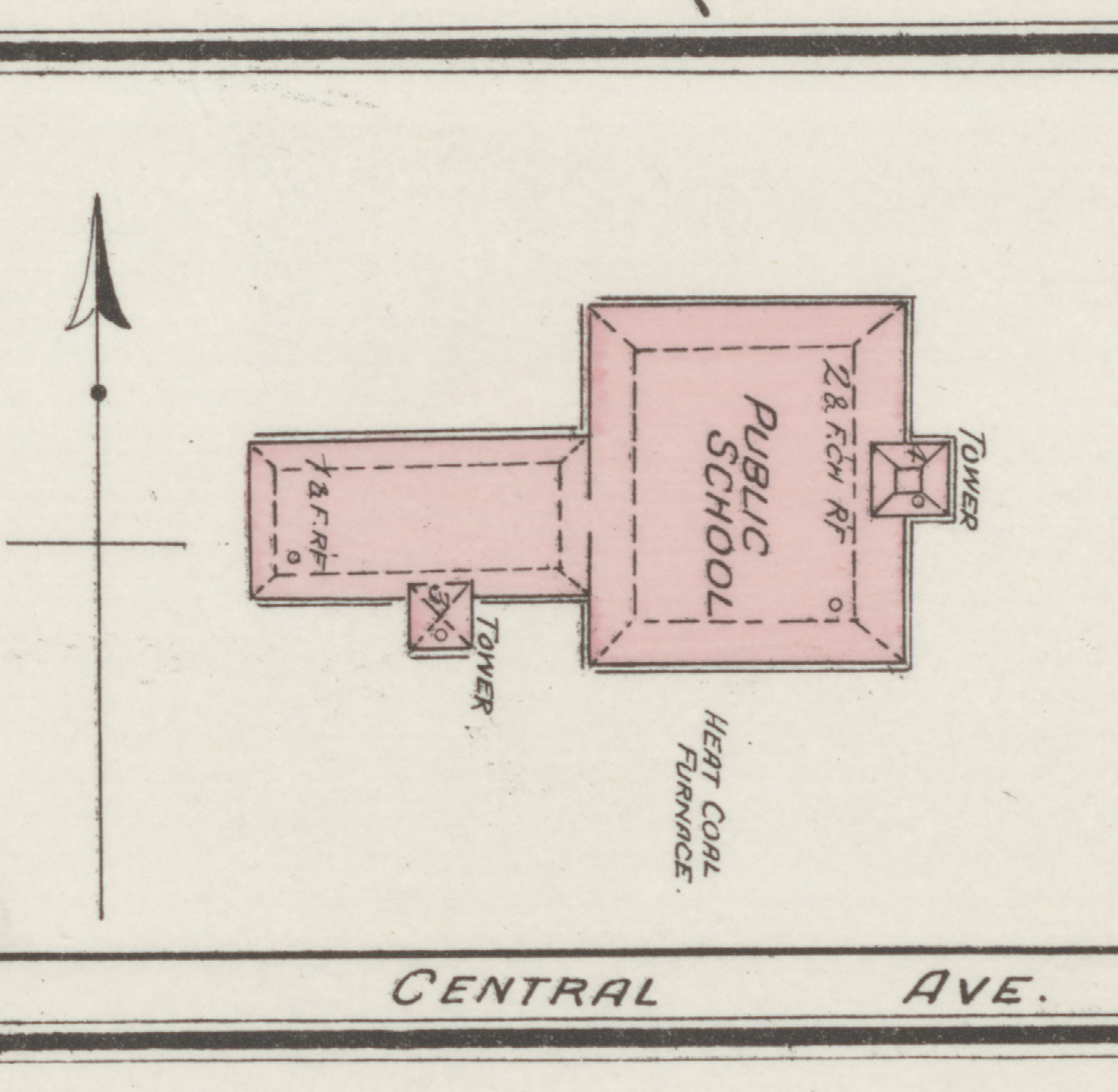
The insurance surveyors drew that school in 1887 and again in 1892. They put the tower where the book put it, marked the roof as French, and measured the main block at about sixty-six feet by seventy-three, which is the book's sixty by seventy within the error of reading a drawing.
By 1901 it is not there. On the same ground at Central and Mountain there is a larger building, three storeys of brick with a two-storey wing, and by 1910 it has electric light and a fire escape bolted to the north wall.
The school that would compare favorably with any of its kind in Northern Indiana lasted about twenty-five years.
Sources
- Counties of LaGrange and Noble, Indiana: Historical and Biographical. The Town of LaGrange chapter, credited to John Paul Jones, F.A. Battey & Co., 1882. Internet Archive. Carries the first school in a barn, the district schools and the teachers named in them, the county seminary and its failure, the Methodist purchase and the seven men who ran it, the sale to Samuel Thurber and on to the Grand Rapids and Indiana Railroad, the removal to the Haw Patch road by the Moon Brothers, and the 1874 brick school in full. Printed page 122 carries the lecture room and the seating figure
- Fire insurance map of La Grange, Indiana, October 1883, Sanborn Map and Publishing Co., 1883. Library of Congress. A single sheet covering the business district around the Public Square. The school grounds lie outside what this edition mapped, so the building is absent from it
- Fire insurance map of La Grange, Indiana, November 1887, sheet 3, Sanborn Map and Publishing Co., 1887. Library of Congress. In a detached inset between Ellison's Addition and Central. PUBLIC SCHOOL in brick, the main block lettered 2 and F.CH RF, which is a French or mansard roof, a separately lettered TOWER marked 3, a rear wing at 1 and F. RF, and HEAT COAL FURNACE. Sheet 2 carries a note reading PUBLIC SCHOOL GROUNDS SEE SHEET NO 3 DETACHED
- Fire insurance map of La Grange, Indiana, November 1892, sheet 1, Sanborn-Perris Map Co., 1892. Library of Congress. In a detached inset at Mountain Street and Central. PUBLIC SCHOOL in brick, the main block lettered 2 and FR. RF., a long west wing at 1 and FR. RF., and WINDOWS lettered along the north wall. Measured against the sheet's own scale bar the main block is about 66 by 73 feet and the wing about 63 by 35
- Fire insurance maps of La Grange, Indiana, March 1901 and August 1910, sheet 6 of each, Sanborn-Perris Map Co. and Sanborn Map Co., 1910. Library of Congress. A different and larger building on the same ground at Central Avenue near Mountain. The main block is lettered 3B and the west wing 2B, with 45 and 60 feet written on the plan. In 1901, HEAT: FURNE. LIGHTS: GAS. In 1910, HEAT: FURNACE. LIGHT: ELECTRIC, and a hatched F.E. for a fire escape on the north wall
The narrative of the seminary and the schools rests on a single chapter of a single volume, the Town of LaGrange chapter of the 1882 county history, which the book credits to John Paul Jones.
Jones taught in the school he describes. The chapter records that he took the remainder of a term at the seminary and resigned when he was elected clerk of the circuit court, so he is writing about his own employment in the third person, and the piece names him doing it.
The 1874 building is the one thing here with a second and independent source: the Sanborn Map Company's fire insurance surveys of 1887 and 1892, and the 1901 and 1910 editions that show what stood on the ground afterwards.
The 1882 text was read from a scanned copy. Obvious scanning errors have been corrected silently and no wording has been altered. The forty-person lecture room is not one of them: it was checked against the page image and the book prints it that way.
More from LaGrange
LaGrange
What the county seat gained and lost
Between 1901 and 1910 LaGrange got a telephone exchange, a fire station, a post office, a pickle factory and an ice cream factory. In the same nine years it lost two churches, a hotel and every printing office in town.