Mongo
He took the office with him
Published .
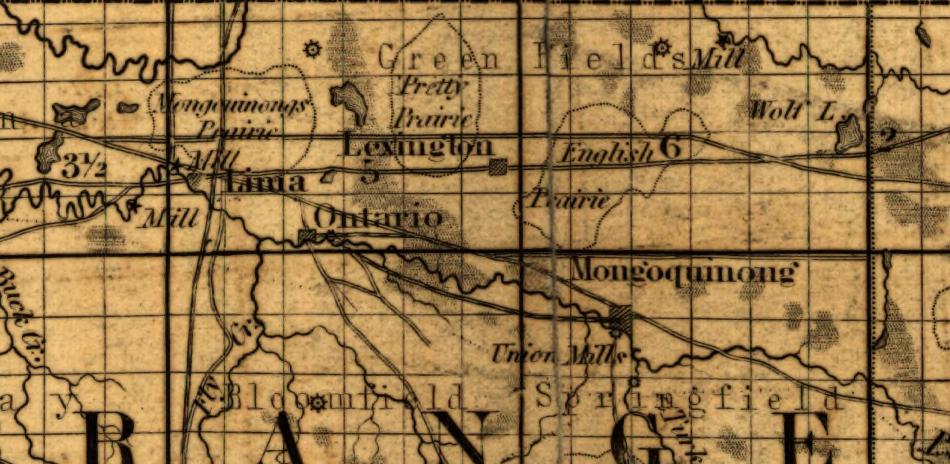
There is a village called Mongo in Springfield Township, on the Pigeon River, in sections five and eight.
There is a town called Howe up on the state line, which was called Lima until 1909, and before that was called Mongoquinong.
Mongo was called Mongoquinong too, and was still called it in 1874.
Start with what the word was.
The 1882 county history puts the meaning in a footnote and does not pretend to be sure of it.
The meaning of the Indian word "Mongoquinong" is uncertain. The most trustworthy reports say that it was applied by the Indians to the prairie east of Lima, the open country being known by that name among the Pottawattomies when the county was first settled by the whites, or even years before, when the Indian traders were the only white persons. Various meanings have been given the term: that it signifies "Big Squaw," or "Big Chief" or "Big White Squaw," or as meaning both man and woman.
Four readings, and the book goes on to take apart the etymology behind the fourth and say it cannot be maintained on good authority. It closes by saying the burden of evidence is Big Squaw. It does not say the matter is settled.
The county atlas of 1893 is more definite and says something else. Its chronology for 1828 records the first settlement in the county as half a mile west of Lima, and calls Lima itself Mongoquinong, or Big Squaw Village. Not a prairie. A town.
And a settler quoted in the 1920 history reverses the whole thing.
When we came to LaGrange County it was inhabited by the Mongoquinong Indians. These Indians belonged to the Pottawattomie tribe, and had inhabited this country for many years. They lived in small tribes, and had been scattered all over this part of the country for many years, and numbered from 1,400 to 1,500 in LaGrange County. The old chief's name was Mongoquinong, and his father and grandfather were born in this section. Of course that name was given to the country in which they resided.
A prairie that named itself, a town, or a man the country was named after. Three accounts, and no source in this county reconciles them.
What is not in doubt is where the name was first.
It was at Lima, and that town has its own piece here, which carries the Potawatomi village, the first white settlers of 1828 and the survey of 1834. Two facts from it matter to this one. The name was on that town. And some time in 1833 or 1834 the legislature took it off by special act and made it Lima.
So by about 1834 the name was free, and a place at the other end of the county ended up with it.
Here is how it got there, and the whole of the evidence is one sentence in one chapter of one book.
While Judge Seeley was at Lima, a post office called Mongoquinong was established there, and he received the appointment as Postmaster. About this time he removed to Greenfield Township, taking the office, which retained the same name, with him. Finally, in about 1833 or 1834, he moved to Springfield Township, and the office was removed to Union Mills, as it was then called, and O'Ferrell, or as some say Nichols, received the appointment as Postmaster; the office still retaining its first name.
A man moved house twice and the post office went with him, and the name went with the post office.
Lima to Greenfield Township. Greenfield Township to Springfield Township. The office kept its first name at every stop, and by the end of it a village on the Pigeon River, at the far side of the county from the prairie the word came from, was receiving mail addressed to Mongoquinong.
The 1882 book is not certain who took over from Seeley. O'Ferrell, or as some say Nichols is the county history hedging inside its own sentence.
The village the name landed on already had one.
Brownell had located a claim there in 1831, dammed the Pigeon and put up a two-storey grist mill, and the place around the mill was called Union Mills. The post office arrived a couple of years after that and brought the older name with it.
By about 1836 Drusus Nichols had bought the mill property, the O'Ferrell store and the distillery. In March of 1840 he had a surveyor lay out about a hundred and eighty lots on sections five and eight.
This was the first plat of Mongoquinong.
Six years after the legislature had taken that name off the town at the other end of the county, it was being written on a plat in Springfield Township.
It stayed on for another thirty-four years.
The county atlas records the end of it in one line in its chronology, under March of 1874: the name of Mongoquinong changed to Mongo. The 1882 history, writing eight years later, says only that the long name has lately been shortened.
Battey never gives Mongo more than a hundred and fifty people.
Neither county history ever says that two towns in it wore the same name. The 1920 volume does it in one book: its miscellaneous chapter calls Howe originally Mongoquinong, and thirteen chapters later its Springfield chapter calls Mongo formerly Mongoquinong, and nothing between them connects the two. The 1893 atlas does it inside one running chronology: Mongoquinong is Lima in 1828, an Indian trading post in 1832, and the place renamed Mongo in 1874.
The 1882 book comes closest, and it is the only one that could have.
It carries the footnote about the word and it carries the sentence about Judge Seeley, and both are on the same printed page.
But the footnote is about what the word meant, not about where it went. And the Lima chapter, which records that the name was taken off that town by act of the legislature, never says that it turned up somewhere else. The Springfield chapter, which records the office arriving with it, never says where it came from.
A reader has to hold two chapters at once to see it. The 1852 map holds both at once by accident: the prairie still lettered by Lima, and the name already lettered on a village at the other end of the county, with Union Mills beside it.
Sources
- Counties of LaGrange and Noble, Indiana. Historical and Biographical, F. A. Battey & Co., 1882. Internet Archive. The Springfield Township chapter for the footnote on the meaning of the word, the Judge Seeley passage, Brownell's claim and mill, Union Mills, Drusus Nichols and the O'Ferrell store, the plat of March 1840, the shortening to Mongo and the population. The Lima Township chapter for the tavern licence to Arthur Burrows and the change of name by act of the legislature. The footnote and the Seeley sentence are both on printed page 202.
- History of Northeast Indiana. LaGrange, Steuben, Noble and DeKalb Counties, Ira Ford, 1920. Internet Archive. Volume one, the miscellaneous chapter for the settler's account of the Mongoquinong Indians and the old chief, and for Howe as originally Mongoquinong and later Lima. The Springfield chapter for Mongo as formerly Mongoquinong, in sections five and eight, platted by Drusus Nichols in 1840.
- Illustrated Atlas and Columbian Souvenir of LaGrange County, Indiana, LaGrange Publishing Company, 1893. Internet Archive. The chronology, for the 1828 entry naming Mongoquinong or Big Squaw Village, the 1831 entry for the first grist mill at Mongo, Union Mills, and the entry under March 1874 recording the change of name to Mongo.
Quotations are taken from scanned originals and no wording has been altered. Four of them sit on damage in the scans and the damage is named here so a later reader does not chase it: Battey's footnote breaks Pottawattomies across a line as "Pot- tawattomiee"; the same book prints a footnote marker directly after Mongoquinong in the Seeley sentence; Ford's settler passage reads "Pbttawattomie" where the scanner misread an o; and the atlas breaks Mongoquinong across a line as "Mongoqui- nong". The footnote's dash is rendered as a colon, which is this site's rule for quoted matter. No source in the corpus states a distance between the two places, so none is given.