LaGrange County
They slept in the woods
Published .
On 16 June 1832 Hart L. Stewart sat down to tell Major General John R. Williams why the men Williams wanted were not coming.
He had issued the orders. He had called a draft, and set the men to meet at White Pigeon on Thursday morning ready to march to Chicago. By two in the afternoon ten or twelve privates had turned up.
The letter is dated but gives no place. All it says of where he was is that he had ordered the men to meet at White Pigeon, and that he was writing after he had got home.
Then he told Williams something that had happened while he was away.
I will relate one circumstance of the kind that came to my knowledge on my arriving at home.
On the Monday before I arived two Indians from a settlement south came onto Magoquinan Prairie with pretended friendship to the cittizens and informed them that on the Next Evening the Indians ware calculating to fall upon the woomen & children and to masecree them all
He is passing on what the settlers were told, not anything he saw.
the story created considerable allarm & some of the famerlies left thare houses & slept in the Woods & others actualy packed & started a moove
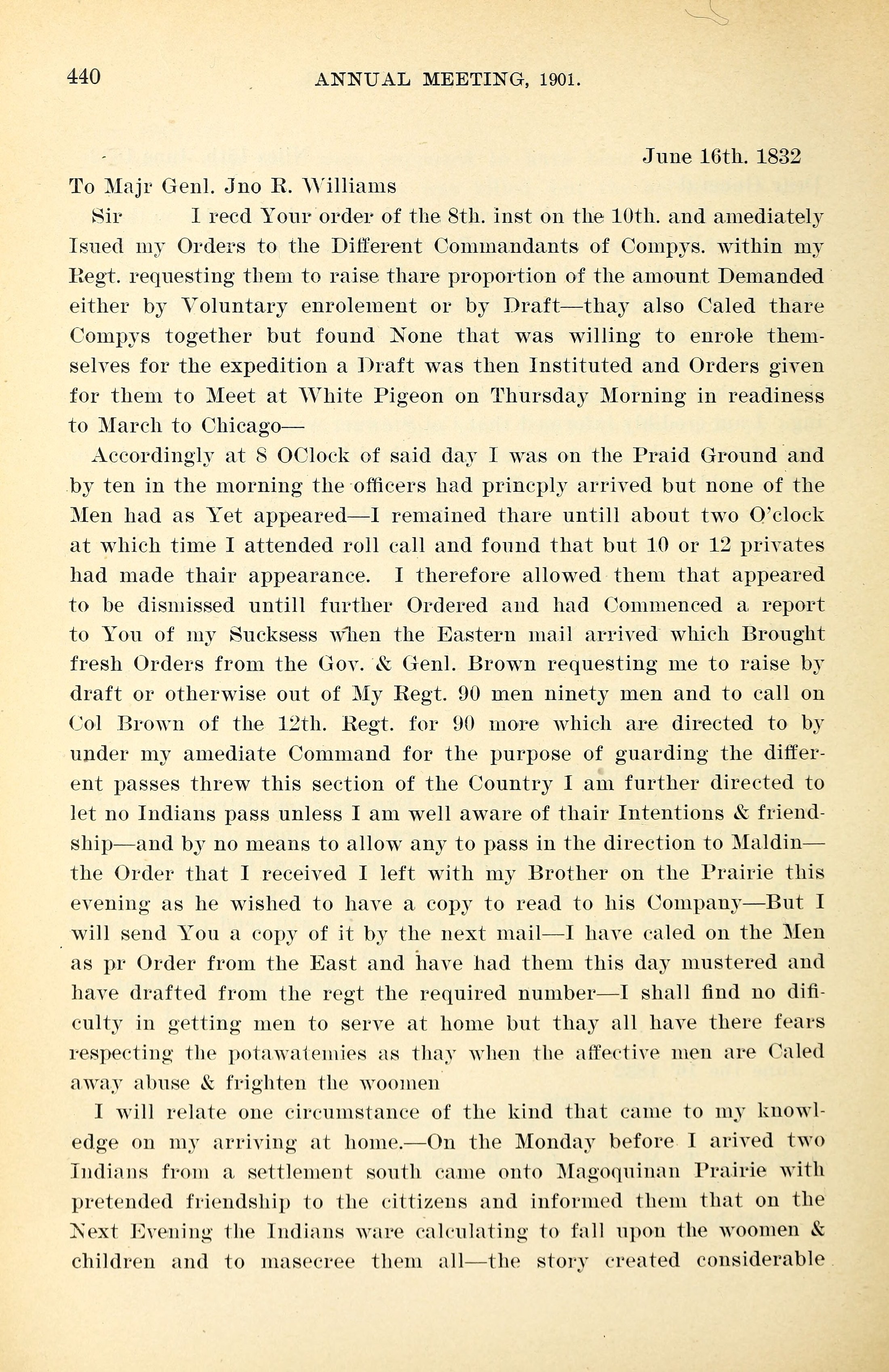
He was writing because the story was the reason his draft had failed. His men would serve at home, he said, but they were afraid for their families if they were marched away, and with such stories going through the settlements every day it would be very hard to get anyone to leave.
That is what the letter is. It was written in the middle of it, by the officer whose men were being called out of the same settlements, while stories like this one were still going through them every day. It was not printed in a county history. It was printed seventy years later in volume thirty-one of the Michigan Pioneer and Historical Society's collections, from the papers of John R. Williams at the Burton Library in Detroit.
The county's own books remember that summer's panic as a prank. In the county history published in 1882, it begins at a mill in the north of Springfield Township, with everyone talking about the Black Hawk War and whether the Potawatomi camped in the county would rise. Men at the mill staged a shooting to frighten two neighbours named Gage and Langdon, who ran north and south telling everyone the Indians had killed everyone at the mill. Families fled, forts were begun at Lexington and on the island in Cedar Lake, and more than a hundred armed men came to the mill. The books call it the Gage and Langdon war, and they tell it as a joke.
The letter and the county's books use the word Indians, as writers did then, and every quotation here keeps the wording as printed.
The county atlas of 1893 has a third version, and there is no joke in it.
An unfounded rumor of hostilities at Mongoquinong, then an Indian trading post, causes settlers to flee to and fortify at Lexington, at a place called "Fort Donaldson."
No mill and no prank. A rumor, and a place it was about. Nobody in it at all sets the county's accounts side by side.
Stewart's Magoquinan and the atlas's Mongoquinong read as the same name. The spelling is the only evidence for that. Nothing else in the letter places the prairie.
The accounts agree on four things: the summer of 1832, a warning of an attack that never came, families leaving their homes, and the name of the prairie.
They disagree about how it began. In the letter, two men came onto the prairie and said an attack was set for the next evening. In the county history, men at a mill faked a shooting, and the news that went out was of a massacre already done.
No county source gives a date. The 1882 history says the summer of 1832, and the atlas files it under 1832. Stewart dates his letter and not the Monday. So nothing joins the accounts to a day, and whether the letter and the county's books describe one alarm or two is not something any source in this archive can settle.
The ground is not pinned down either, because in these books Mongoquinong is two places. The 1882 history calls Lima "Mongoquinong, now called Lima", and the atlas puts the county's first post office on "Mongoquinong Prairie". That is the town that has had three names. The same 1882 volume says Brownell "located a claim at what is now Mongoquinong" and built his mill there, and that is Mongo, which carried the name too.
Stewart wrote prairie. The atlas wrote trading post. The 1882 history has a trading house at Lima in 1830 and 1831 and another at Mongo until the autumn of 1832, so a trading post fits either.
The county wrote that summer down three times. The history of 1882, fifty years after it. The atlas, in 1893. The history of northeast Indiana, in 1920.
Stewart's letter is dated 16 June 1832, with the stories still going through the settlements.
Only one of them was written while it was happening.
Sources
- Historical Collections: Collections and Researches Made by the Michigan Pioneer and Historical Society, Vol. XXXI, Michigan Pioneer and Historical Society, 1902. Internet Archive. Hart L. Stewart to Maj. Gen. John R. Williams, 16 June 1832, printed pages 440 to 441, IIIF leaves 466 and 467, under the heading The Black Hawk War. The volume's note on page 438 places the originals in the Williams Papers, Burton Library, Detroit.
- Counties of LaGrange and Noble, Indiana: Historical and Biographical, F.A. Battey and Co. Chapter I by J. H. Rerick; Lima, Springfield and Greenfield Township chapters by Weston A. Goodspeed, 1882. Internet Archive. Printed pages 17, 139, 196 to 198 and 224 to 225.
- Illustrated Atlas and Columbian Souvenir of LaGrange County, Indiana, LaGrange Publishing Company, 1893. Internet Archive. Chronology of LaGrange County, printed page 53, IIIF leaf 57, entry for 1832.
- History of Northeast Indiana: LaGrange, Steuben, Noble and DeKalb Counties, 1920. Internet Archive, volume 1. Springfield Township chapter, printed page 173, and the county chronology, printed page 117.
The letter is quoted from the page image of the printed volume, with its spelling exactly as printed, including arived, cittizens, ware, woomen, masecree, allarm, famerlies, thare, actualy and moove. Where the printed letter runs one clause into the next with a dash, the quotation is broken at that point and no wording has been altered. The county history and atlas passages are taken from scanned originals and were read off the page images.
More from LaGrange County
LaGrange County
Legally called
For twenty-three years the Wabash through the south of this county was, on paper, another company. The state taxed it under that name, the railroad kept its accounts under it, and none of the county's own books ever used it.