LaGrange County
The perverse running of the railway too far to the north
Published . Last updated .
Before the railroad there was a road to Fort Wayne, and before that an Indian trail.
The county history published in 1882 sets the sequence out plainly. First the trail, allowing travel in single file only, by man or beast. Then the common wagon road, then the stage line, then the plank road, and finally the railroad.
The Fort Wayne road was laid out in 1832 and it carried nearly all the surplus grain the county sold and nearly all the merchandise it bought. Everything went out that way and everything came in that way, by wagon, for close to forty years.
The plank road came and went. Stockholders found that only loss could result in its maintenance, and it was abandoned.
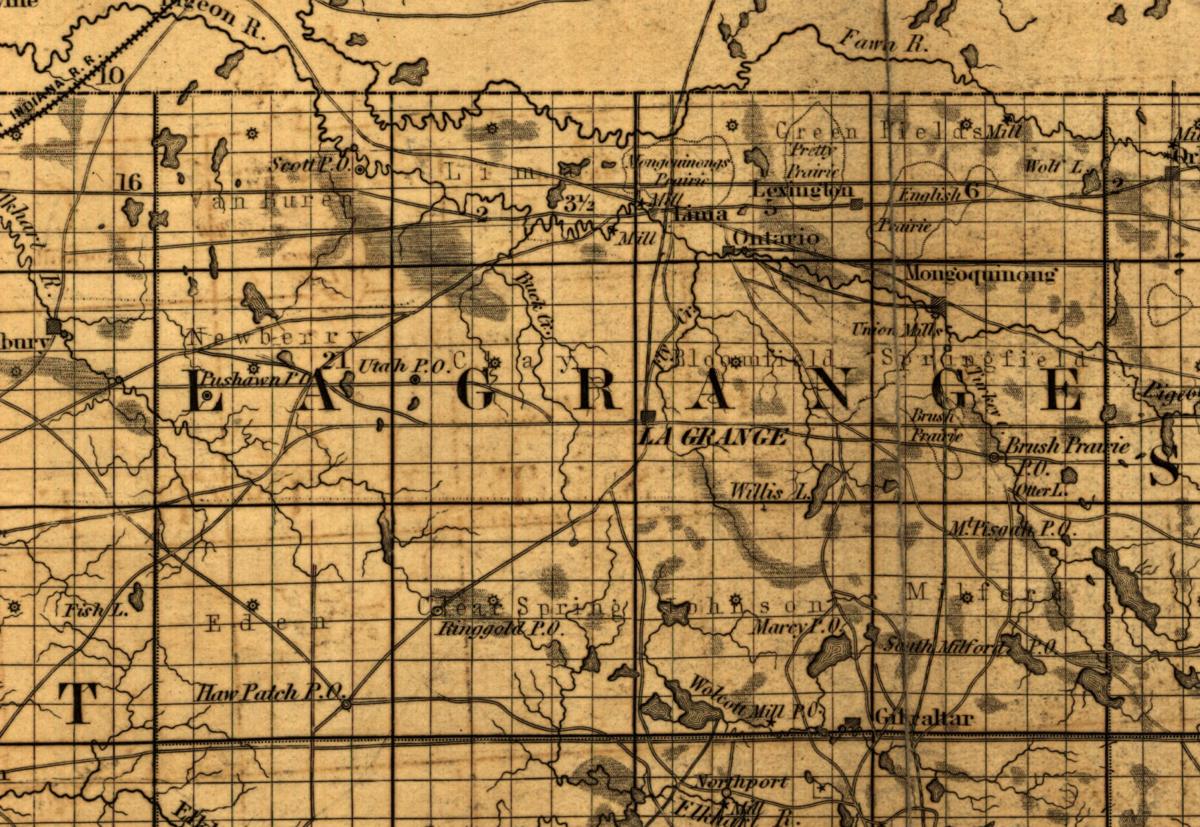
The first railroad anybody talked about here was the Buffalo and Mississippi, chartered in 1836 to run along the northern tier of counties. The commissioners subscribed five hundred dollars of stock and issued two thousand in bonds.
It was never built.
Then the Michigan Southern, and for a while people were confident it would have to come through here. In the autumn of 1850 the company's chief engineer came to Lima to see John B. Howe about the right of way, and found him gone. Howe was at Indianapolis as this county's delegate to the convention writing Indiana's new constitution.
The road went north instead, through Michigan, and reached Chicago without touching this county at all.
That decision cost more than a station. When the same company later needed an air line from Toledo to Elkhart, the first survey ran through the southern townships of this county, and it would probably have been built there but for what the 1882 history calls extraordinary activity of some capitalists at Kendallville.
Rerick, who wrote that chapter, allows himself an estimate of what it cost.
the towns of the county would now be much larger than they are and the population at least one-half more
The road that finally came was the Grand Rapids and Indiana, and the county paid for it.
The agitation began in 1855 and about a hundred thousand dollars was subscribed by individuals, nearly all of them along the line. Not by the county, which had learned something from the Buffalo and Mississippi. By people, one at a time, along the route it would take.
The first locomotive reached LaGrange from Sturgis on the eleventh of April, 1870.
The 1882 history records the reception. The roar of cannon and music by the band, flags swung to the breeze, smiles brightening every face, men shaking hands and then thrusting them down into their pockets to provide a sumptuous dinner at the hotels for all the track layers and railroad employes.
That season the line was finished from Sturgis to Fort Wayne. The next year, Sturgis to Grand Rapids.
Five years earlier, this county had sent companies to the war on foot. Every one that rendezvoused at Fort Wayne marched there or went by wagon, with half the town walking as far as Wolcottville, where somebody had laid on a picnic dinner.
The stock was almost worthless.
By 1882 it had reached ten cents on the dollar, which the county history reports as an improvement. Richard Thompson of Clay, a whole-souled and pious old man, put his property into it and saw it seldom attain fifteen cents.
Charles Woodruff, at Albion in the next county, subscribed almost his total possessions during the excitement and was ruined financially. The sketch that records it is his son's, O. L. Woodruff, a merchant at Wolcottville.
And Rerick, writing twelve years after the road opened, records what the people who lost the money thought about it.
few, if any, who took stock complain of the investment
What the road did to the towns it reached is visible within months.
Valentine did not exist. Immediately after the line was finished, Sergeant and Clugston built a sawmill there and a village grew around it. At Lima the schoolhouse that Howe and S. P. Williams and others had paid five hundred dollars for, built years before there was any such thing, now stood where the depot stands.
In LaGrange, Ruick put up a warehouse near the depot in 1870 and went into produce and commission. George Burbridge came from Michigan, learned telegraphy at Oberlin, worked the Michigan Central and then Fort Wayne and Winchester and Sturgis, and in December of 1876 the Grand Rapids and Indiana made him agent at LaGrange. A man whose whole trade existed because the line did.

And then there were the towns that waited.
Van Buren had been flourishing and promising, and the 1882 history says what happened to it in one clause.
would have fulfilled all its early promise had it not been for the perverse running of the railway too far to the north
Bloomfield's hamlet was platted in September of 1836 and was a rival for the county seat. It lost the county seat to LaGrange, and then the railroad was located through LaGrange too, and it still remains but a mere hamlet.
In Johnson Township a man who owned the corners refused to sell lots to the mechanics and artisans who asked for them. The history is blunt about it: had he encouraged its growth, as he alone could, the Grand Rapids and Indiana might be running through the place today.
Newbury had its hopes raised to a considerable height by the talk of the Buffalo and Mississippi, and deeply sunk by its failure. Then a preliminary survey of the Baltimore and Ohio raised them again, and the same thing happened.
The Haw Patch came closest.
In 1872 the Canada Southern extension was surveyed through it. There was talk of railroad shops being located there. Thomas H. Gale of Michigan bought over a section of improved land at high figures, as a speculation, and the road seemed certain to come.
but the panic of 1873 came instead
Clearspring had it twice. Before 1850 a line was surveyed through the southern part of the township with positive assurances of building, and hopes of a rise in land values and a flourishing town. Then in 1872 the Chicago and Canada Southern was, in the history's own words, in fact a sure thing.
But the panic of 1873 came, and Clearspring is still without a railroad
In January of 1873 the county voted on whether to put up ninety-eight thousand dollars for a line running east and west through the middle of it, the New York and Chicago Air Line.
It was defeated, 1,520 against and 1,220 for.
The financial crisis came a few months later, and nothing more was heard of that enterprise or of several others. A narrow gauge from Lake Michigan to Toledo, much talked of in 1880, with public meetings and much running to and fro, and that was all. An extension of the Detroit, Hillsdale and Northwestern, strongly advocated in 1880, with a large sum subscribed in the northeast of the county. A preliminary survey by the Lake Shore in the winter of 1880 for a track from Toledo through Angola and LaGrange to Goshen.
By 1882 the county had 16.57 miles of railroad in it and had spent five hundred and fifty-seven thousand dollars on construction and equipment.
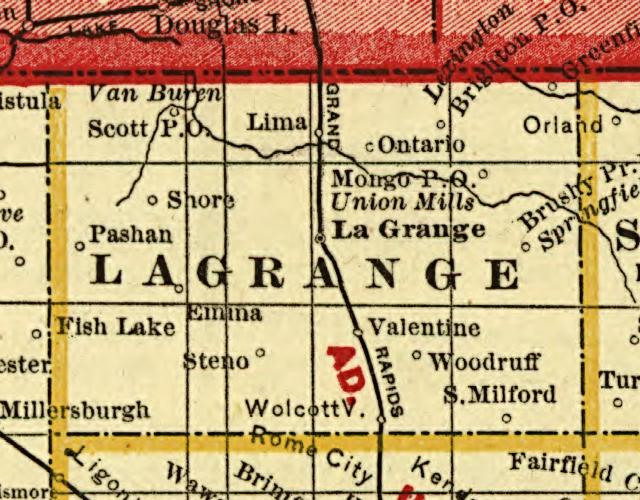
The waiting ended, and it took another twenty years.
The Goshen and Sturgis branch of the Lake Shore came through Lima, Van Buren and Newbury, with stations at Shipshewana and Seybert. The Wabash was built through the county early in the 1890s and finished about 1893, with stations at Topeka, Eddy and South Milford, and at Wolcottville just over the line in Noble County. The St. Joseph Valley line was completed about 1900, running east from Shipshewana through Newbury, Clay, Bloomfield, Springfield and the corner of Greenfield.
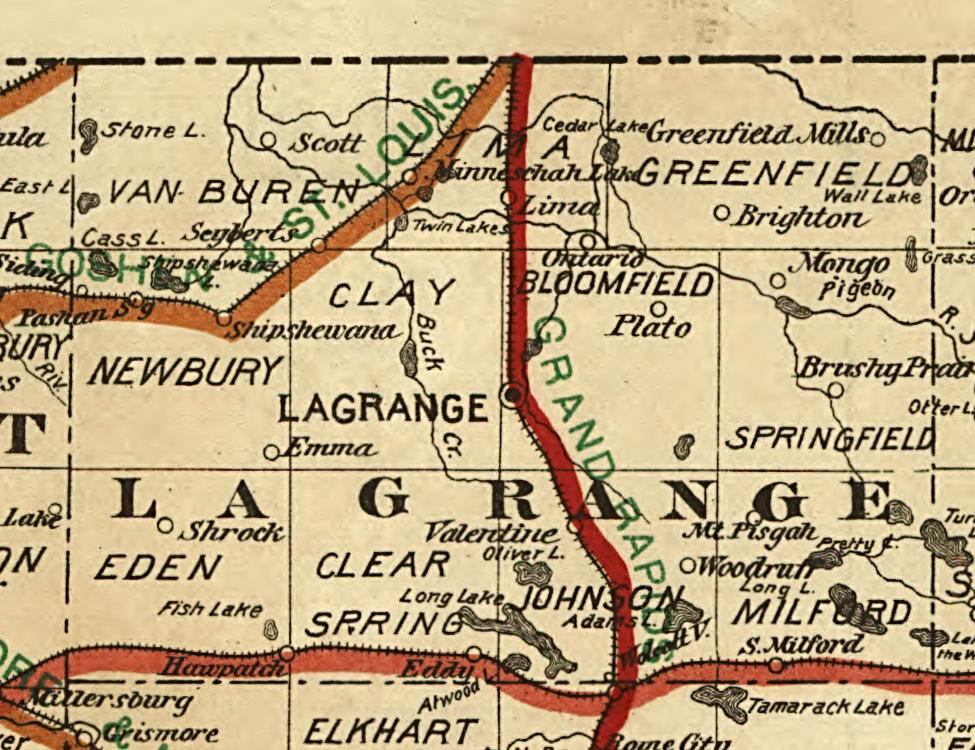
The railway mail service mapped the result the year after, lettering twenty stations inside the county, from Scott and Shipshewana in the north west to South Milford in the south east.
By 1920 the county had 78.90 miles of main track where it had once had sixteen and a half.
Van Buren got its line. Newbury got two. Clearspring did not.
Sources
- Counties of LaGrange and Noble, Indiana. Historical and Biographical, F. A. Battey & Co., 1882. Internet Archive
- History of Northeast Indiana. LaGrange, Steuben, Noble and DeKalb Counties, Ira Ford, 1920. Internet Archive
Every quotation is from the 1882 county history and was verified against a scan of the original before publication, passage by passage, along with the research pull the piece was written from. Chapter III, on roads and railways, is signed by Dr. John H. Rerick, and the township chapters and biographical sketches supply the rest. Obvious scanning errors have been corrected silently and no wording has been altered. The word "employes" is the volume's own spelling and stands. The account of the first locomotive's reception runs as reported speech rather than as a quotation, because the sentence is broken across a page by a running head and does not exist in the source as one continuous sentence. Ford's 1920 volume tells that morning differently and this piece follows the 1882 account throughout. The two books also disagree about mileage: the 1882 table gives 16.57 miles of railroad in the county, and Ford's 1920 county auditor figures give the Grand Rapids and Indiana alone 16.89 in the county against 78.90 miles of main track. Ford's own table lists four companies, at 16.89, 21.52, 13.36 and 13.16 miles, which sum to 64.93 rather than 78.90, and he does not say what the remainder is. This piece uses the 1882 and 1920 totals and makes no argument about the difference.
Since publication
Correction ·
The source note said Ford's 78.90 miles of main track was the figure for all four lines. His county auditor table lists four companies at 16.89, 21.52, 13.36 and 13.16 miles, which sum to 64.93. That clause is removed and the arithmetic is now disclosed. The figures in the piece itself, 16.57 for 1882 and 78.90 for 1920, are the two books' own totals and are unchanged.
Correction ·
This piece said the Wabash took in Topeka, Eddy, Wolcottville and South Milford, following the 1920 county history's list of the line's stations in LaGrange County. Three of the four were in this county and Wolcottville's was not. The State Board of Tax Commissioners, which valued every railroad building by county and township, lists the Wabash's buildings in LaGrange County at South Milford, Eddy and Topeka, in 1894, 1896, 1899 and 1905, and lists the Wolcottville station under Orange Township, Noble County. The same 1920 history's own table of the line's mileage in this county agrees: it divides the Wabash's miles among Milford, Johnson, Clearspring and Eden townships and East and West Topeka, with no Wolcottville entry, while its table for the Grand Rapids and Indiana line does carry one. The sentence now says the Wolcottville station stood just over the county line.
More from LaGrange County
LaGrange County
Two windmills from Lima and a traction engine from Sturgis
The 1920 county history remembers Isaac Lehmer as inventor of one of the first traction engines. He patented two windmills from Lima in 1871 and 1872, and the traction gear in 1885 from Sturgis, Michigan. The county kept the memory and lost the man.